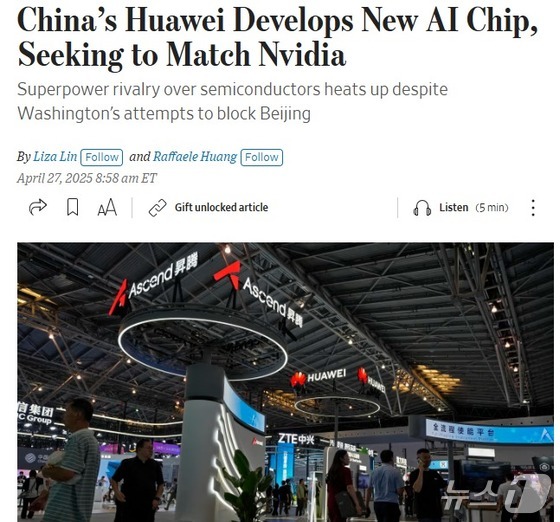
The Wall Street Journal (WSJ) reported on Sunday that China’s Huawei is developing its own chips to counter U.S. semiconductor export restrictions, aiming to replace Nvidia’s high-performance artificial intelligence (AI) chips.
According to sources cited by the WSJ, Huawei plans to launch its latest AI chip, the Ascend 910D, as early as late May.
Huawei anticipates that this chip will outperform Nvidia’s current flagship, the H100.
The Ascend 910D is the next-generation chip following Huawei’s previously developed 910B and 910C models.
Huawei’s rapid succession of chip releases underscores China’s push to accelerate domestic development in response to U.S. restrictions.
In recent years, the U.S. government has imposed export controls on advanced semiconductors in China. For example, it prohibited the export of Nvidia’s H100, considered one of the most powerful AI chips in mass production, even before its 2022 release.
To navigate U.S. restrictions, Nvidia has been selling a lower-performance version, the H20, to the Chinese market. However, the U.S. Department of Commerce recently decided to restrict exports of the H20 to China as well.
Consequently, Huawei is doubling its efforts to achieve self-sufficiency in AI-specific chips.
The WSJ observed that Huawei’s technological progress, despite Washington’s regulations, demonstrates the resilience of China’s semiconductor industry.
Huawei, a leading Chinese tech firm, has been under intense U.S. scrutiny since the first Trump administration. However, the company continues to defy expectations by developing high-end smartphones like the Mate 60 series using its self-developed semiconductors, even in the face of stringent U.S. export restrictions on advanced chips implemented in 2023.