

The General Secretary of the Workers’ Party of Korea, Kim Jong Un, has mentioned the term Intermediate Waters for the first time. This has raised concerns on Thursday that North Korea may have unilaterally redefined the maritime boundary between North and South Korea.
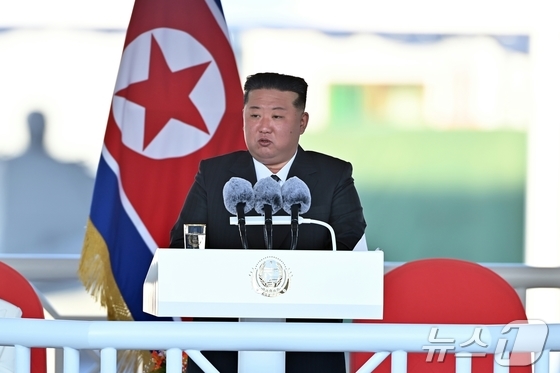
During the launch ceremony of the new 5,000-ton multipurpose destroyer Choe Hyon at the Nampho Shipyard on April 25, Kim stated that they will implement the multipurpose destroyer construction plan in phases. These ships will operate in coastal defense areas and intermediate waters during peacetime.
This statement suggests an intention to increase naval activity, but Kim did not provide specific details about the location or definition of these intermediate waters.
The term intermediate waters has appeared for the first time in North Korean media. Analysts believe this move is closely tied to North Korea’s recent efforts to redefine inter-Korean relations as a two-state relationship, as declared during the 2023 Workers’ Party plenary meeting and the 2024 Supreme People’s Assembly.
Maritime boundary disputes are more prevalent in the Yellow Sea, which is narrower than the East Sea. North Korea has consistently rejected the Northern Limit Line (NLL) established by the commander of the United Nations Command in 1953 between the five South Korean-controlled islands in the Yellow Sea and North Korea’s Hwanghae Province.
In 2004, North Korea claimed to have established a Yellow Sea Guard Line south of the NLL, asserting it as the true maritime boundary. This move is seen as an attempt by Pyongyang to control a larger area of the Yellow Sea and secure more marine resources.
These conflicting claims have led to numerous incidents of North Korean vessels crossing the NLL, resulting in localized clashes such as the First and Second Battle of Yeonpyeong and the Battle of Daecheong.
Some experts speculate that the intermediate waters may be similar to the previously claimed Yellow Sea Guard Line, possibly reflecting North Korea’s new stance of treating inter-Korean relations as those between two separate countries rather than a divided system.
The main concern is North Korea’s declaration to incorporate the two-state concept into its constitution. This could lead to the inclusion of their newly defined maritime boundary in the constitution, potentially escalating efforts to undermine the NLL. The president of the University of North Korean Studies, Yang Moo-jin, warns that this strategy could result in military provocations by North Korea at any time.
However, some analysts note that North Korea’s use of intermediate waters in English-language reports might suggest a more general or broad concept rather than a specific new maritime boundary.
Since the two-state declaration, Kim has frequently referred to areas near the NLL as border lines. During a missile test of the ground-to-sea missile Padasuri-6 last February, he used terms like the northern limit line and the maritime border.
The lack of specific location details in these statements has led some to believe that North Korea may be maintaining strategic ambiguity. By using various internationally recognized terms, they may be emphasizing maritime sovereignty without explicitly establishing new boundary lines.
As North Korea plans to deploy the new destroyer in early 2025, the specific location of these intermediate waters may become clearer. Alternatively, if a revised socialist constitution reflecting the two-state concept is made public, it could provide more insight into North Korea’s new maritime boundary claims.