


Korea Advanced Institute of Science and Technology (KAIST) announced that Professor Yoon Sang Ho’s research team from the Graduate School of Cultural Technology has received two Best Paper Awards at the Conference on Human Factors in Computing Systems (CHI) for their innovative virtual reality (VR) precision pointing and choreography creation technologies.
The award-winning technologies are T2IRay, developed in collaboration with Professor Yang Zhang from the University of California, Los Angeles (UCLA), and ChoreoCraft, a tool designed to enhance creative freedom for choreographers in VR environments.
T2IRay introduces a novel input method that expands on traditional thumb and index finger gestures, allowing users to manipulate virtual objects with unprecedented precision and freedom.
Unlike previous systems, where hand position or orientation changes could disrupt input or reduce accuracy, T2IRay maintains precise pointing capabilities regardless of hand placement or direction, resulting in more fluid and natural interactions.
The technology accurately maps subtle thumb movements within a coordinate system and incorporates natural head movements, enabling seamless manipulation across various virtual spaces.
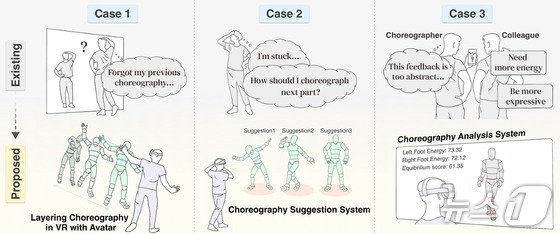
ChoreoCraft addresses key challenges professional choreographers face during the creative process, such as the need to memorize complex sequences of movements and the frustration of receiving vague feedback when experiencing creative blocks.
In VR, users can use motion-capture-based avatars to save and modify movements directly. The system also suggests new choreography harmonizing with music and previous movements, enhancing the creative flow. Moreover, ChoreoCraft analyzes kinematic elements like balance, stability, and activity levels to provide data-driven feedback, increasing the objectivity of the creative process.
Professor Yoon expressed his commitment to continuing research on human-centered interaction, stating that future work will merge physical artificial intelligence (Physical AI) and human-computer interaction (HCI) technologies to expand human capabilities in real and virtual worlds, pushing beyond the boundaries of spatial computing.