

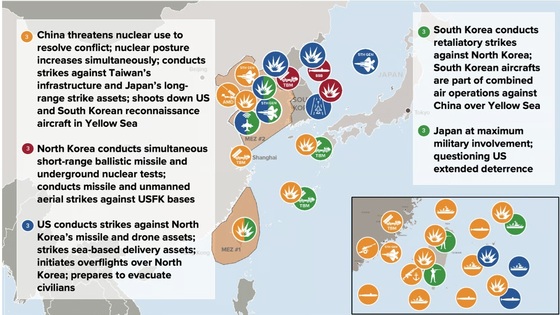
A U.S. think tank, in collaboration with the Department of Defense, recently conducted a tabletop exercise (TTX) envisioning a scenario in which a 2030 war between China and Taiwan expands into a broader conflict involving the Korean Peninsula and Japan.
The exercise reflects Washington’s recognition of the strategic linkage between cross-strait tensions and the security environment on the Korean Peninsula. Observers note that the results could influence future discussions about the role of U.S. Forces Korea (USFK), including potential defense cost-sharing hikes. This issue could resurface under a second Trump administration.
The Atlantic Council released the results of the Guardian Tiger exercise on May 12. Supported by the Defense Threat Reduction Agency (DTRA), the TTX featured two key scenarios: Guardian Tiger I, in which North Korea attacks South Korea, and Guardian Tiger II, in which China attempts to seize Taiwan by force.
In the Guardian Tiger II simulation, China’s invasion of Taiwan leads to a conventional war with the United States. South Korea publicly denounces Beijing’s aggression but refuses to offer military assistance to Taiwan or allow U.S. forces stationed in Korea to intervene. In response, China strikes U.S. bases in Japan with missiles. Japan, in turn, boosts its support for U.S. operations by enhancing logistics, supplies, and ISR (intelligence, surveillance, and reconnaissance) capabilities.
Amid the unfolding crisis, North Korea exploits the situation by launching limited provocations aimed at ultimately driving out U.S. forces from the peninsula. Pyongyang fires short-range ballistic missiles (SRBMs) at key U.S. military facilities in South Korea and conducts nuclear tests designed to challenge Washington’s extended deterrence commitments. The simulation also explores potential aerial clashes between U.S. and Chinese fighter jets.
In the later stages of the scenario, China uses nuclear weapons against Taiwan and invokes its alliance with North Korea to justify intervening on the Korean Peninsula. North Korea follows suit, launching low-yield nuclear strikes on South Korean airbases and deploying troops along the DMZ in preparation for full-scale conventional conflict.
A U.S. official who participated in the exercise stated that the scenario highlights the need to prepare for the possibility that regional crises could escalate into nuclear confrontations with threats to the U.S. homeland.
This TTX comes amid increasing speculation that Washington may revise the mission scope of U.S. forces in South Korea to prioritize countering China. Analysts suggest exercises like Guardian Tiger could serve as blueprints for redefining USFK’s future strategic role.
The Atlantic Council concluded that command-and-control structures in the Indo-Pacific must be updated to account for the potential of simultaneous conflicts with both China and North Korea.