

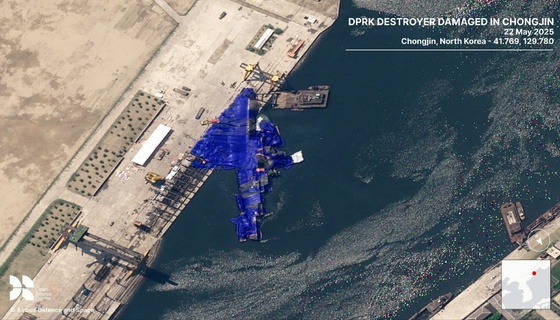
Contrary to Pyongyang’s claim that its second 5,000-ton destroyer suffered only minor damage after capsizing during launch, new satellite imagery suggests the ship may be a total loss.
The U.S. Think Tank Center for Strategic and International Studies (CSIS) published the images on its BEYOND PARALLEL website on May 22, confirming Significant Damage to the warship.
The photos show the destroyer lying on its port side, covered by a blue waterproof tarp and surrounded by crane barges and other support vessels.
CSIS analysts say the accident unfolded much as North Korean media first reported: a wheeled transporter under the bow either snagged on a rail or fell away, causing the stern to drop into the water while the bow remained on the side launch ramp.
The report suggests that if deck barges were operating on the ramp without thorough inspection, it could have been enough to cause the mishap. It also notes that side-ramp launches demand substantial structural integrity.
The group also points to inexperience at Chongjin Shipyard in North Hamgyong Province, which normally builds merchant ships, fishing trawlers, and dredgers—not large surface combatants.
While the exact extent of the damage remains unclear, CSIS doubts the vessel—North Korea’s second Choe Hyon–class destroyer—will join the fleet any time soon and says a total write-off is possible.
North Korean state media acknowledged on May 22 that a Serious Accident occurred the previous day as Kim Jong Un watched the launch at Chongjin. Officials blamed poor command and careless handling, saying the aft launch cradle disengaged first, puncturing the hull and throwing the ship off balance.
Pyongyang later walked back that account, insisting there was no hull breach and only a limited amount of seawater entered through an aft passageway. The regime said restoring stability would take two to three days and repairing the ship’s starboard side could be done in about 10 days.