

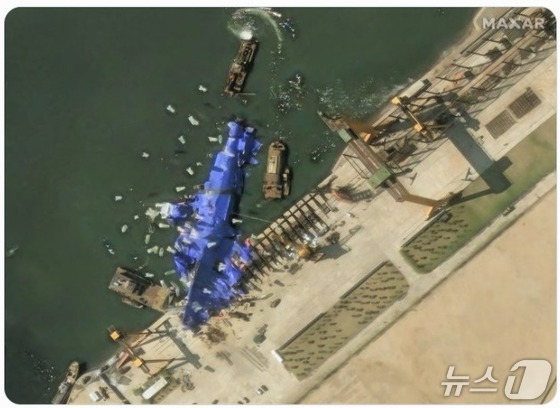
Satellite imagery reveals North Korea has attached multiple balloon-like objects to a new 5,000-ton destroyer that capsized during its launch at the Chongjin Shipyard. This development was observed on Tuesday. Analysts speculate these objects may be an attempt to buoy the damaged vessel.
Decker Eveleth, a strategic forces analyst at the Center for Naval Analyses (CNA), shared satellite images of the incident site on his X account on Monday. The photos clearly show several small objects affixed to the North Korean destroyer.
Based on the tarpaulin covering the destroyer and the shadows cast on the water, these objects appear to be floating in the air, resembling balloons.
Eveleth humorously suggested that North Korea might be attempting to salvage the destroyer using a method inspired by the Pixar film Up, where a house is lifted into the sky by balloons.
U.S. military sources have confirmed North Korea’s use of balloon-like objects on the capsized destroyer. A military official stated that North Korea has deployed unidentified balloon-shaped objects above the tarpaulin and on the water. Further noting it’s currently analyzing the specifics of this situation.
However, experts in the U.S. believe North Korea isn’t trying to float the ship but rather using buoyancy materials to prevent further sinking of the capsized vessel. They note this isn’t a standard salvage technique, suggesting North Korea is improvising a solution.
Choi Il, the director of the Submarine Research Institute and a former Navy Captain, commented that North Korea is taking measures to halt further sinking. And that North Korea will likely attempt to right the hull soon.
A defense industry insider remarked that, frankly, this is an unprecedented approach. Further, it doesn’t seem technically viable.
The incident occurred on May 22 when North Korea’s new destroyer capsized and sustained damage during its launch ceremony at the Chongjin Shipyard in the East Sea. North Korean officials claimed it would take 2-3 days to pump out water from flooded compartments and separate the bow from the launch platform to restore balance, with an additional 10 days for hull repairs. However, many experts anticipate a significantly longer recovery process for the vessel’s full restoration.