

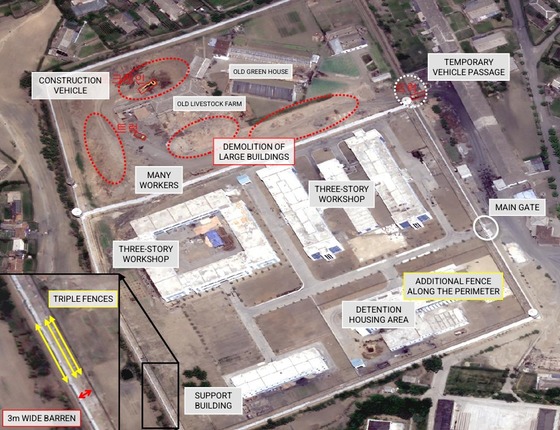
Recent satellite imagery has uncovered evidence of renovations at North Korea’s political prison camp in Sinuiju, North Pyongan Province. Experts suggest that this overhaul serves a dual purpose: addressing international concerns about facility conditions while potentially repurposing the camp as a production hub for generating foreign currency.
According to an artificial intelligence (AI)-powered analysis by SI Analytics (SIA), a satellite imagery firm, the Sinuiju camp renovations began in early 2024.
SIA’s satellite images from December 2023, May, October, and December of last year, as well as June of this year, reveal the camp’s new layout. It now comprises distinct agricultural and detention zones. In the agricultural area, inmates have been relocated to four newly constructed large buildings, while the former detention facilities have been demolished.
The renovations have significantly bolstered the camp’s security measures. The number of watchtowers has increased from three to seven, and the perimeter fence has been upgraded from a single layer to a triple-layer system. The gap between the innermost and outermost fences now spans three meters.
SIA noted that while North Korean defectors have previously reported the presence of electric fences and minefields, these claims cannot be verified through current satellite imagery, necessitating further investigation.
Additional fencing appears to have been installed within the detention area. SIA’s analysis suggests that two large buildings in the northern part of the facility now serve as workshops for manufacturing products such as wigs and false eyelashes.
SIA stated that the year-long construction at the Sinuiju concentration camp demonstrates North Korea’s willingness to allocate resources and its capacity for reconstruction. Further, noting that long-term, it appears they intend to exploit inmate labor to produce key export goods for China, effectively turning the camp into a foreign currency generator.
The Sinuiju concentration camp is believed to have been established in the late 1960s. SIA characterized the current renovations as the first significant overhaul in approximately 55 years, likely a response to sustained international pressure on human rights issues from organizations like the United Nations (UN) Human Rights Office in Seoul and the Committee for Human Rights in North Korea (HRNK).
The UN Office of the High Commissioner for Human Rights (OHCHR) has repeatedly called on the North Korean government to address the inhumane conditions and severe food shortages in its detention facilities. A report detailing efforts to hold the North Korean regime accountable for human rights violations was submitted to North Korean officials in February of this year. Still, no response has been received to date.