

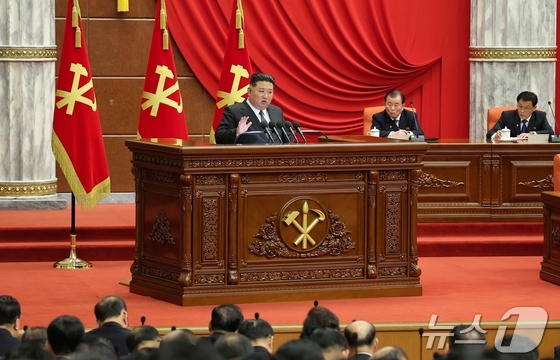
North Korea’s 12th plenary meeting of the 8th Central Committee of the Workers’ Party, initially scheduled for late June, is widely expected to convene this week. The session, which will review developments from the first half of the year and set major policy directions for the second half, is drawing attention amid speculation over whether Pyongyang will deliver new messages to the United States and South Korea.
The plenary meeting is North Korea’s most significant party assembly, during which national affairs are reviewed, progress is assessed, and policies are revised or newly introduced. Since 2021, these meetings have been held twice a year — once in late June and again in December.
While the mid-year plenary typically serves as an interim review, this session carries added weight as it will be the first since President Donald Trump took office in January and South Korea’s President Lee Jae Myung assumed office in June. North Korea’s response to these leadership transitions is being closely watched.
Trump has repeatedly highlighted what he described as a special rapport with North Korean leader Kim Jong Un, voicing enthusiasm for another summit. Recent reports suggest that Pyongyang rejected a letter Trump attempted to send to Kim.
The Lee Jae Myung administration has been extending olive branches to North Korea, including strong measures to prevent the distribution of anti-North Korean leaflets and suspending loudspeaker broadcasts to the North after a year-long hiatus.
Meanwhile, the Lee Jae Myung administration has made efforts to ease tensions with the North by taking firm measures to block the distribution of anti-North Korean leaflets and by suspending loudspeaker broadcasts across the border, which had resumed for about a year.
As a result, some observers believe North Korea — which maintained a confrontational stance toward the Biden administration and largely ignored the Yoon Suk Yeol government — could use this upcoming meeting to signal a shift in its diplomatic posture.
Adding complexity to the situation are rising tensions in the Middle East. On Sunday, the U.S. carried out airstrikes on Iranian nuclear facilities in Fordow, Natanz, and Isfahan. North Korea may view this as a troubling precedent, especially since Iran was bombed during active nuclear negotiations with Washington — an episode likely to reinforce skepticism within Pyongyang about the reliability of the United States.
North Korea has also signaled a continued push to strengthen ties with Russia, announcing the dispatch of engineering and construction personnel to Russia’s Kursk region. It plans to conduct high-level exchanges in the lead-up to the 80th anniversary of the Workers’ Party’s founding in October. As such, the upcoming plenary is expected to include significant discussions on North Korea–Russia relations.