

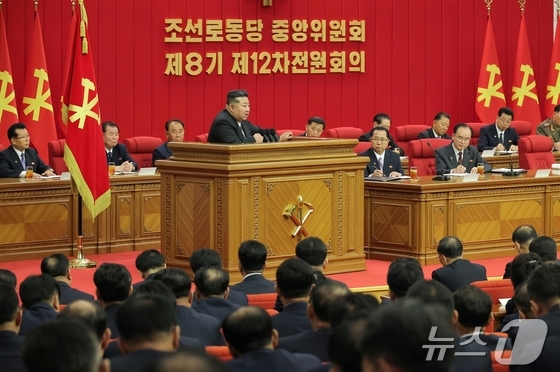
North Korea displayed extreme caution when it publicly announced the results of the 12th Plenary Meeting of the 9th Central Committee of the Workers’ Party on Tuesday. The meeting, held from June 21 to 23, was convened to review the first half of the year. Notably, the regime refrained from mentioning any discussions or even the fact that talks were held regarding South Korea or the U.S. The South Korean government interprets this as North Korea’s intention to approach the fluid international situation cautiously.
According to the Workers’ Party’s official newspaper, Rodong Sinmun, the plenary meeting included reports on achievements in various fields, including politics, economy, culture, science, education, and national defense, during the first half of the year. It was reported that Kim Jong Un, the General Secretary of the Party, personally presided over the meeting and delivered an important speech.
However, North Korea did not release the full text or even a summary of Kim’s speech. There were no reports of messages directed toward the U.S. or South Korea, nor any disclosure of party-level discussions.
The newspaper dedicated two out of its six pages to coverage of the plenary meeting, which is the smallest amount of coverage for a first-half review plenary meeting since 2021.
This plenary meeting was the first to be held since President Donald Trump’s inauguration in January and South Korean President Lee Jae Myung’s inauguration on June 4. As such, there was significant interest in whether North Korea would alter its foreign policy stance in response to the leadership changes in the U.S. and South Korea.
Notably, President Trump has consistently extended invitations to dialogue with North Korea. President Lee has also pledged to promote inter-Korean dialogue and ease tensions, implementing concrete measures such as halting loudspeaker broadcasts directed at North Korea. These developments had led to speculation that North Korea might make modest adjustments to its foreign policy approach.
North Korea’s decision to withhold a substantial portion of the plenary discussions appears to be a strategic move. While recognizing the need for a change in its approach to the U.S. and South Korea, Pyongyang may have concluded that significant shifts are difficult at this juncture.
Despite the U.S. calling for dialogue with conciliatory language, North Korea likely finds it challenging to trust the U.S. This skepticism stems from recent events, such as the large-scale U.S. bombings on Iran during nuclear negotiations, which significantly impacted Iran’s nuclear capabilities.
Regarding South Korea, North Korea has been implementing its two-state policy since 2024, as decided in the December 2023 party plenary meeting. This policy has led to the removal of concepts like nation and unification from various policies and social aspects. Consequently, it may be difficult for North Korea to reciprocate immediately with the conciliatory approach of President Lee’s administration.
When the President Lee administration announced its intention to control the distribution of anti-North Korea leaflets by civilian organizations and halted loudspeaker broadcasts that had been ongoing since last year, North Korea responded by stopping its broadcasts aimed at the South, aligning with tension reduction measures. Additionally, during the launching ceremony of a new 5,000-ton destroyer on June 12, Kim’s typically aggressive remarks were notably absent, which the Ministry of Unification considered a point of interest.
North Korea appears to be prioritizing the completion of its five-year economic and defense development plan, established during the 8th Party Congress in 2021, in the latter half of this year. The regime seems to place greater importance on developing its relationship with Russia, which has become unprecedentedly close.
At this plenary meeting, North Korea confirmed the upcoming 9th Party Congress, which will establish the national governance direction for the next five years, commencing next year. This congress, likely to be held in late 2025 or early 2026, is expected to finalize and publicly announce new foreign policy principles and directions.
South Korea’s Ministry of Unification stated that North Korea’s reporting style reflects consideration of the uncertain policies of South Korea and the U.S. towards North Korea, as well as the fluid international situation, including the Russia-Ukraine conflict and the Israel-Iran conflict. The ministry will closely monitor messages that may emerge from the upcoming 9th Party Congress.
Professor Lim Eul Chul from Kyungnam University’s Institute for Far Eastern Studies analyzed that North Korea is currently adopting a cautious stance while observing the external environment. He suggests that this is a strategic choice to avoid unnecessary escalation of tensions, focus on managing relations with Russia, and concentrate on achieving internal objectives.