

North Korea has dispatched a delegation from Kim Il Sung Military University to Russia.
According to Rodong Sinmun on Tuesday, the delegation departed from Pyongyang International Airport the previous day to visit the Military Academy of the General Staff of the Russian Armed Forces.
The front page carried a report highlighting the completion of 160,000 jeongbo (approximately 64,750 hectares) of irrigation works, describing it as a new step toward the modernization of rural management. The article also noted that more than 3,300 jeongbo (around 1,335 hectares) of dry fields had been converted into rice paddies. Within just over ten days since the start of the wheat and barley harvest, 98% of harvesting and 95% of threshing had reportedly been completed.
On the second page, the paper emphasized that achieving balanced and simultaneous development across all regions was both a key strategy for advancing North Korean-style socialism and a political goal rooted in the state ideology of prioritizing the people.
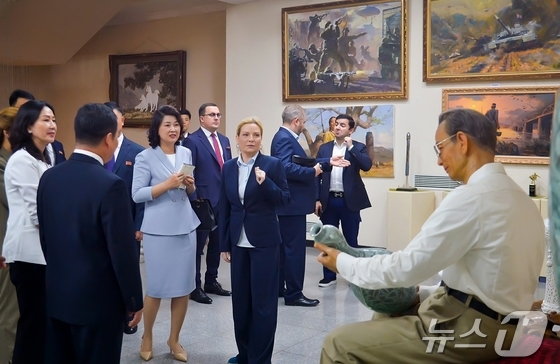
The third page reported that a Russian cultural delegation visited several symbolic institutions in Pyongyang, including the Juche Music Art Development Theater, the National Gifts Exhibition House, and the Mansudae Art Studio. Elsewhere in the paper, a serialized feature highlighted the rehabilitation of the Komdok Mining Region, which was heavily damaged by a typhoon five years ago. The article framed its recovery as a symbol of national reconstruction and resilience.
The fifth page focused on the Ministry of Railways, which was said to be securing agricultural materials and organizing dedicated freight trains to ensure timely delivery. The ministry was reportedly reviewing daily logistics results and responding to emerging challenges accordingly. The report also mentioned that officials in charge of locomotives, freight cars, rail infrastructure, and power systems were working to ensure that key transport trains reached their destinations without delay.
The sixth page introduced anti-U.S. propaganda posters displayed at an art exhibition on the theme of class education. The paper asserted that, regardless of the passage of time or changes in generations, North Korea would not forget what it referred to as the crimes of U.S. imperialism, and claimed the country was determined to exact what it described as a just revenge many times over for past bloodshed.