

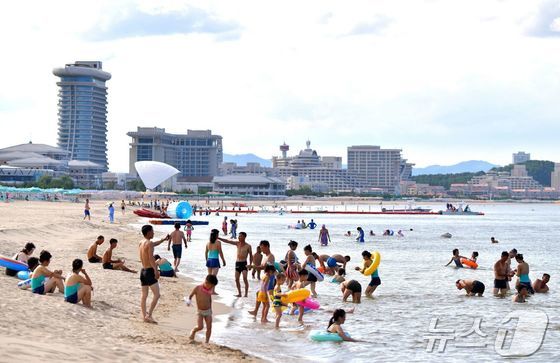
North Korea has been intensively promoting the Wonsan Kalma Coastal Tourist Zone, which opened on Tuesday. Domestically, the regime is showcasing Kim Jong Un’s people-first ideology while externally demonstrating the ineffectiveness of international sanctions and signaling its intention to boost foreign currency earnings.
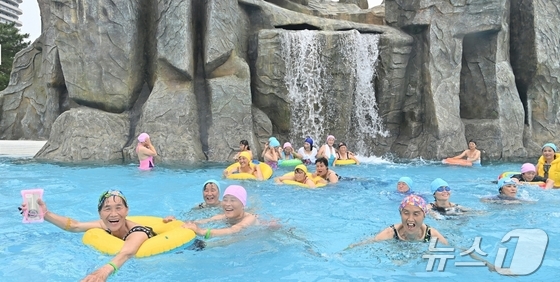
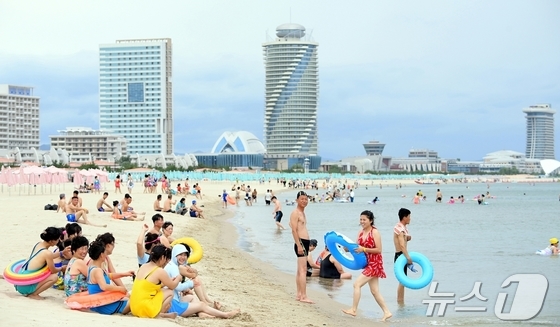
The Workers’ Party’s official newspaper, Rodong Sinmun, featured the Kalma Tourist Zone on its front page on the 3rd with an article titled “The People’s Laughter Echoes Endlessly Across the East Sea’s Beautiful Beach.” The previous day, the newspaper had also promoted the zone’s opening, hailing it as an unparalleled, magnificent tourist destination.
The development of the Kalma Tourist Zone, situated along Myeongsasimri Beach in Wonsan, Gangwon Province, has been North Korea’s ambitious project for over a decade. Following the 2014 decision by the Supreme People’s Assembly Standing Committee to develop the Wonsan-Mount Kumgang International Tourist Zone, plans were detailed to transform the Kalma area into a world-class tourist destination with hotels and cultural entertainment facilities.
Initially slated for completion in 2019, the project faced significant delays due to international sanctions and the COVID-19 pandemic.
Geographical constraints and restrictions on free tourism make attracting foreign tourists challenging
North Korea plans to open the Kalma Tourist Zone to foreign tourists soon. The Russian news agency TASS reported that a group of Russian tourists would visit for an eight-day trip starting on July 7th. However, experts suggest that consistently attracting Russian tourists may prove difficult. Affluent Russians from Moscow or St. Petersburg are unlikely to view North Korea, a 15-hour flight away, as an appealing destination. Relying solely on tourists from nearby Vladivostok and the Far East region is seen as insufficient.
China, with its numerous luxury resorts, is also not expected to consider Wonsan a major tourist destination, except for curiosity-driven visitors, due to long-term restrictions on free travel and the area’s strict controls.
Given these limited tourism prospects, North Korea is focusing on promoting a positive image, claiming that workers from across the country are flocking to the coastal resort for seaside vacations. Simultaneously, the regime is using the project’s completion to highlight its people-first ideology, portraying it as a result of the supreme leader’s commitment to the welfare of the people, thus fostering internal unity.
Rachel Minyoung Lee, a Senior Fellow at 38North, noted that the opening of major beach resorts, such as the Kalma Tourist Zone, helps reinforce the promotion of Kim Jong Un’s people-first ideology.
Lee Jae Myung administration’s conciliatory approach… Is North Korea eyeing improved relations with South Korea?
In this context, the opening of the Kalma Tourist Zone is likely to be used to showcase tangible achievements as North Korea concludes the final year of its five-year economic development plan established in 2021.
Professor Lim Eul Chul from Kyungnam University’s Institute for Far Eastern Studies interpreted this as a message proving the ineffectiveness of U.S. and international sanctions against North Korea, emphasizing that it’s important for North Korea to convey this message to the international community. Professor Park Won Gon from Ewha Womans University’s Department of North Korean Studies noted that while North Korea’s economy hasn’t significantly improved, it has left little to showcase to its people. He explained that even if the regime promotes this as Kim Jong Un’s achievement, North Korean citizens may view these facilities as unattainable luxuries.
Some speculate that if attracting foreign tourists proves challenging, North Korea might seek to leverage its relationship with South Korea. North Korea has announced plans to finalize major projects for promising large-scale tourist and cultural zones at the 9th Workers’ Party Congress, scheduled for late this year or early next year, potentially including Mount Kumgang near Wonsan.
Since 2022, North Korea has been pushing for the redevelopment of Mount Kumgang, demolishing older facilities, including those built by South Korea. While the unilateral demolition remains a significant issue, there’s cautious speculation that if North Korea engages in dialogue with the Lee Jae-myung administration, which has shown a conciliatory stance, the Mount Kumgang and Wonsan areas could become focal points for improved relations.
Professor Park believes the Wonsan Kalma Tourist Zone was a project doomed to failure from the start, adding that they had no choice but to welcome South Korean tourists to avoid complete failure.