

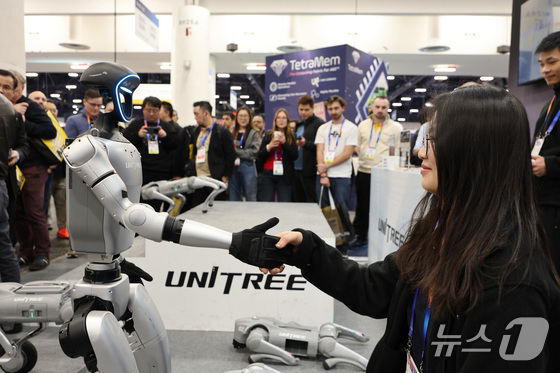
China’s humanoid robot industry is ramping up for mass production this year, marking a significant expansion in its business operations.
Wang Xingxing, founder and Chief Executive Officer (CEO) of Unitree Robotics (Unitree), a leading Chinese humanoid robot company, acknowledged that while the industry is still in its early stages, he anticipates a rapid acceleration of applications in industrial settings within the next three to five years.
Wang Xingxing: Robot Industry Growth Accelerates, Shipments Notably Increase This Year
During a press conference hosted by the State Council Information Office of the People’s Republic of China on Tuesday, CEO Wang reported that since the launch of their humanoid robot G1 last year, global interest has surged, with widespread demand for the product. He noted a significant increase in shipments compared to the previous year.
Wang emphasized the rapid growth and clear technological advancements in the first half of this year, not just for his company but for the entire robotics industry. He attributed this progress to supportive policies and a conducive environment, which have bolstered confidence in research, development, and production, leading to an influx of new products and technologies.
While acknowledging that humanoid robots are still in the early stages of industrial development, Wang predicted that within the next three to five years, we’ll see accelerated implementation and practical applications in industrial sites and hazardous environments.
Wang also highlighted the potential for collaboration with the U.S. in the robotics sector. He noted China’s strong hardware production and manufacturing base, complementing the U.S.’s robust artificial intelligence (AI) software ecosystem, suggesting that both nations could benefit from leveraging their respective strengths.
Emphasizing his company’s commitment to an open collaborative ecosystem, Wang pointed to their history of developing open-source software and the numerous customers currently developing applications for their robots.
Addressing the challenges facing the robotics and AI industries, Wang emphasized the importance of global cooperation to advance the field, enhance technologies and products, and ultimately deliver better services.
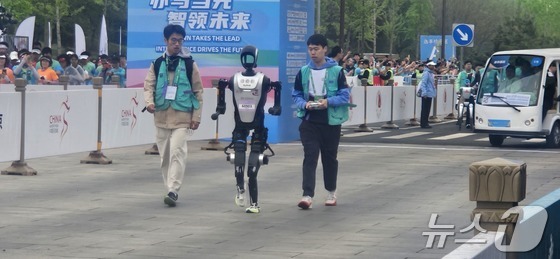
A humanoid robot runs during the humanoid robot half marathon in the Yizhuang Economic Development Zone in Beijing, China, on April 19
China’s Humanoid Robot Mass Production Year: Expectations for a New Economic Engine
In a recent development, a subsidiary of China Mobile, the country’s largest telecom company, placed a substantial order for human-sized, general-purpose robots from Zhiyuan (Agibot), valued at 78 million CNY (about 10.88 million USD). Concurrently, Unitree received an order for small humanoid robot hands with five fingers, valued at 46.05 million CNY (approximately 6.42 million USD). Local media outlets interpret China Mobile’s significant order as a clear indication that this year is indeed shaping up to be the beginning of mass production for humanoid robots, as previously predicted.
Earlier in March, Shanghai’s Tongji University ordered ten humanoid robots from Unitree for educational purposes, with a contract value of 8.25 million CNY (about 1.15 million USD). During the same period, FundaTech entered into a 7.98 million CNY (approximately 1.11 million USD) contract with Tsinghua University for the development of humanoid robot technology.
According to TrendForce, eleven Chinese humanoid robot manufacturers announced plans for mass production last year. Their combined production value is projected to exceed 45 billion CNY (about 6.28 billion USD) this year. Leng Xiaokun, founder of Leju Robotics, anticipates delivering between 1,000 and 2,000 humanoid robots this year, with the potential to reach 10,000 units next year if they hit the 2,000-unit mark.
The founder of Booster Robotics suggests that 2025 could be considered the stage of small-scale mass production, emphasizing that key factors will be the reliable delivery of humanoid robots and their ability to create value in real-world applications.
The rapid advancement of China’s humanoid robot industry, particularly in sensing, movement, and AI models, has been bolstered by strong government support. China has designated the humanoid robot industry as a strategic emerging sector, with regions like Beijing, Shanghai, Zhejiang, and Guangdong implementing supportive policies.
Bo Zhang, director of the Computer Software Research Institute at Wuhan’s Donghua Academy, wrote in Guangming Daily that China’s humanoid robots are breaking technological barriers at an unprecedented pace, becoming a new engine for the qualitative development of productive forces. He noted that the explosive growth of large language models in AI, particularly those developed by DeepSeek, has significantly advanced the field of humanoid robotics.
Zhang predicts that humanoid robots will become the next frontier in technological innovation, following computers, smartphones, and electric vehicles (EVs). Market analysts anticipate that by 2035, the global humanoid robot market could rival the size of the EV market.