

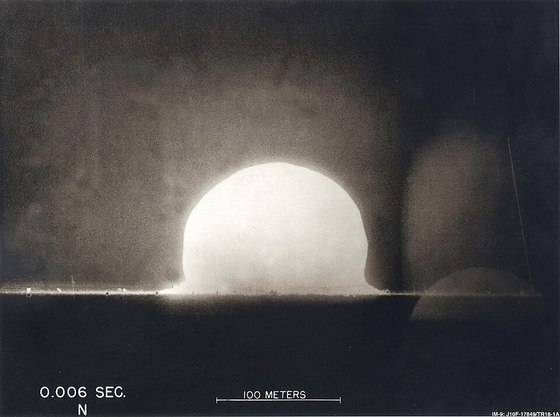
On July 16, 1945, the world witnessed a pivotal moment in military history as the first successful nuclear weapon detonation, codenamed Trinity, lit up the desert sky in Alamogordo, New Mexico. This groundbreaking test marked a seismic shift in warfare capabilities, reshaping the final stages of World War II and setting the stage for a new global order in the post-war era.
At precisely 5:30 a.m., the Trinity test erupted with a blinding flash that pierced the early morning darkness. Within seconds, a massive fireball surged hundreds of meters skyward, rapidly morphing into the now-iconic mushroom cloud. The sheer power of the blast generated shockwaves detectable from dozens of miles away, signaling the dawn of a new age in military might.
The Trinity test represented the pinnacle achievement of the Manhattan Project, a covert Allied initiative that began in 1942. This massive undertaking, spearheaded by the U.S. with crucial support from British and Canadian scientists, was born out of fears that Nazi Germany might develop nuclear capabilities first. The project stands as one of the most ambitious scientific endeavors in history, employing hundreds of thousands and costing tens of billions of dollars in wartime currency. Under the leadership of physicist J. Robert Oppenheimer, a team of brilliant minds pushed beyond theoretical physics to achieve a controlled nuclear fission chain reaction. This feat would forever alter the face of global conflict.
The success of Trinity heralded the arrival of the atomic age, proving that harnessing and weaponizing nuclear fission was no longer a theoretical concept but a devastating reality. This breakthrough would soon play a decisive role in bringing World War II to a swift conclusion, providing the United States with an unprecedented tactical advantage to force Japan’s surrender.
Yet, as the dust settled in the New Mexico desert, it became clear that this scientific triumph also ushered in an era of unprecedented danger. The specter of nuclear warfare, capable of annihilating entire cities with a single strike, would come to dominate post-war international relations and fuel decades of intense arms races between global superpowers.
The Trinity test stands as a testament to humanity’s scientific prowess and the double-edged nature of technological advancement. While it showcased our capacity for innovation, it also raised profound ethical questions about the responsibilities that come with such formidable power. The flash that illuminated the Alamogordo Desert that fateful day opened a new and complex chapter in human history—one whose repercussions continue to shape our world and military strategy to this day.