

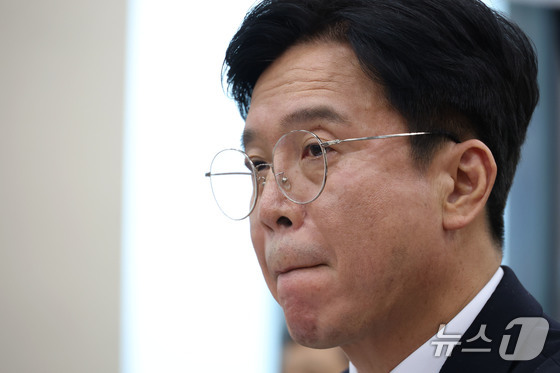
The nomination of Kim Young Hoon for Minister of Employment and Labor of South Korea sparked a heated debate between political parties on Wednesday during his confirmation hearing when he stated that North Korea is not the main enemy. The People Power Party demanded that Kim clarify his stance on North Korea, leading to their collective walkout from the hearing. Meanwhile, the Democratic Party of Korea proceeded with the hearing alone.
The opposition party focused its criticism on Kim’s attempt to visit North Korea following Kim Jong Il’s death in 2011, and his role as chairman of the Korean Confederation of Trade Unions the following year, where he organized a Workers’ Unification Golden Bell event that allegedly promoted North Korean propaganda. The ruling party defended Kim, arguing that questioning a Labor Minister nominee about North Korea was inappropriate.
Both parties convened at the National Assembly for a full committee meeting of the Environment and Labor Committee to conduct Kim’s confirmation hearing.
Representative Jo Ji Yeon of the People Power Party stated that as a public official, Kim must uphold the Constitution and respect the nation’s liberal democratic system. She further asked him who the main enemy of South Korea is.
Kim asked if she was asking about the current main enemy and responded that the main enemy is any force that endangers South Korea. He further explained that there could be various factors. Jo pressed further that if North Korea is the main enemy of South Korea.
Kim replied that the Minister of Unification stated yesterday that it is not the main enemy, expressing his agreement with the statement.
Following this exchange, Kim Hyung Dong, the opposition party’s secretary on the Environment and Labor Committee, called for a recess, stating that it appears the nominee has not clearly articulated his thoughts on the most crucial issue, particularly regarding who the main enemy of South Korea is. He further stated that as a potential cabinet member and Labor Minister, it’s vital for him to have a clear understanding of South Korea’s identity, values, and stance toward North Korea. He asked the nominee to express his position unequivocally during this hearing.
The Democratic Party swiftly countered, labeling the questions as excessively political.
Representative Kim Tae Seon argued that the notion of North Korea as the main enemy isn’t enshrined in the Constitution or laws. He explained that while the Defense Minister might view North Korea as the main enemy, the Unification Minister, whose goal is reunification, may not. Kim stated that perceptions vary based on one’s political stance.
He further explained that the view of North Korea as the main enemy has fluctuated across different administrations, arguing that it is inappropriate to impose one perspective. He concluded by saying he doesn’t understand why this has become such a contentious issue.
Meanwhile, the People Power Party concentrated its efforts on probing Kim’s stance on North Korea.
Representative Woo Jae Jun pointed out the nominee’s application to visit Pyongyang for a condolence visit on December 27, 2011. Woo asked if Kim was aware that the Cheonan sinking incident occurred just a year earlier, in 2010. He criticized that Kim was not in a position to express condolences, stating that even the government at that time refrained from official condolences due to the loss of soldiers.
Kim defended his position, stating that he believed that paying respects could help ease tensions in inter-Korean relations. He explained that the greatest victims of war are the workers.