

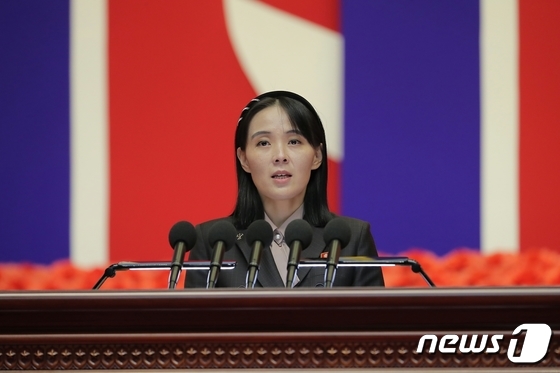
Kim Yo Jong, the Deputy Department Director of North Korea’s Workers’ Party, declared that North Korea will not engage in dialogue with South Korea, regardless of any policies pursued in South Korea. This marked the first official response from North Korea to the Lee Jae-myung administration’s North Korea policy.
According to the Korean Central News Agency on Monday, in a statement titled “Inter-Korean Relations Have Completely Moved Beyond the Concept of Kinship,” Kim emphasized that no matter how much the Lee Jae-myung government tries to attract attention and gain international spotlight by feigning kinship and making a show of doing all manner of righteous deeds, there will be no change in North Korea’s perception of South Korea as a hostile state. She added that the historical trajectory which fundamentally altered inter-Korean relations cannot be reversed.
Kim further declared that North Korea has no interest in any policies or proposals emanating from Seoul, emphasizing that they officially reaffirm that there will be no opportunity for dialogue or discussion with South Korea.
Regarding the conciliatory gestures of the Lee Jae-myung government, Kim stated that if South Korean authorities take the cessation of psychological warfare broadcasts as the first signal to restore inter-Korean trust, they are merely addressing problems of their own making. She further stated that whatever actions South Korea takes remain their issue, and it is simply an attempt to undo measures they should never have taken in the first place.
Reflecting on the period of severed inter-Korean relations, Kim asserted that whether South Korea claims to be democratic or conservative, it can never be a partner for reconciliation and cooperation. She asserted that North Korea has reached a significant historical conclusion that they can now part ways with a history constrained by rhetorical expressions of kinship and discard outdated concepts that defy reality.
Kim also pointed out that even just over 50 days into Lee Jae-myung’s presidency, while rhetoric about easing tensions on the Korean Peninsula and improving inter-Korean relations is abundant, their blind faith in the U.S.-South Korea alliance and confrontational stance towards North Korea remain unchanged from their predecessors. She claimed that the U.S. and South Korea are likely to continue shifting the blame for the deteriorating situation on the Korean Peninsula onto North Korea.
Furthermore, regarding the proposal to invite Kim Jong Un to the Asia-Pacific Economic Cooperation (APEC) summit in Gyeongju, Kim dismissed it as a delusion.
Kim asserted that if South Korea, which has unilaterally declared North Korea its principal adversary and nurtured an atmosphere of extreme confrontation, now expects to undo all the consequences of its actions with a few sentimental words, there could be no greater miscalculation.
The statement released by Kim did not appear in Rodong Sinmun, the official newspaper of the Workers’ Party of Korea.
Rodong Sinmun plays a crucial role in propaganda and mobilization aimed at North Korean citizens. Analysts suggest that the decision not to publish the statement for the public might be a strategy to gauge South Korea’s reaction.