

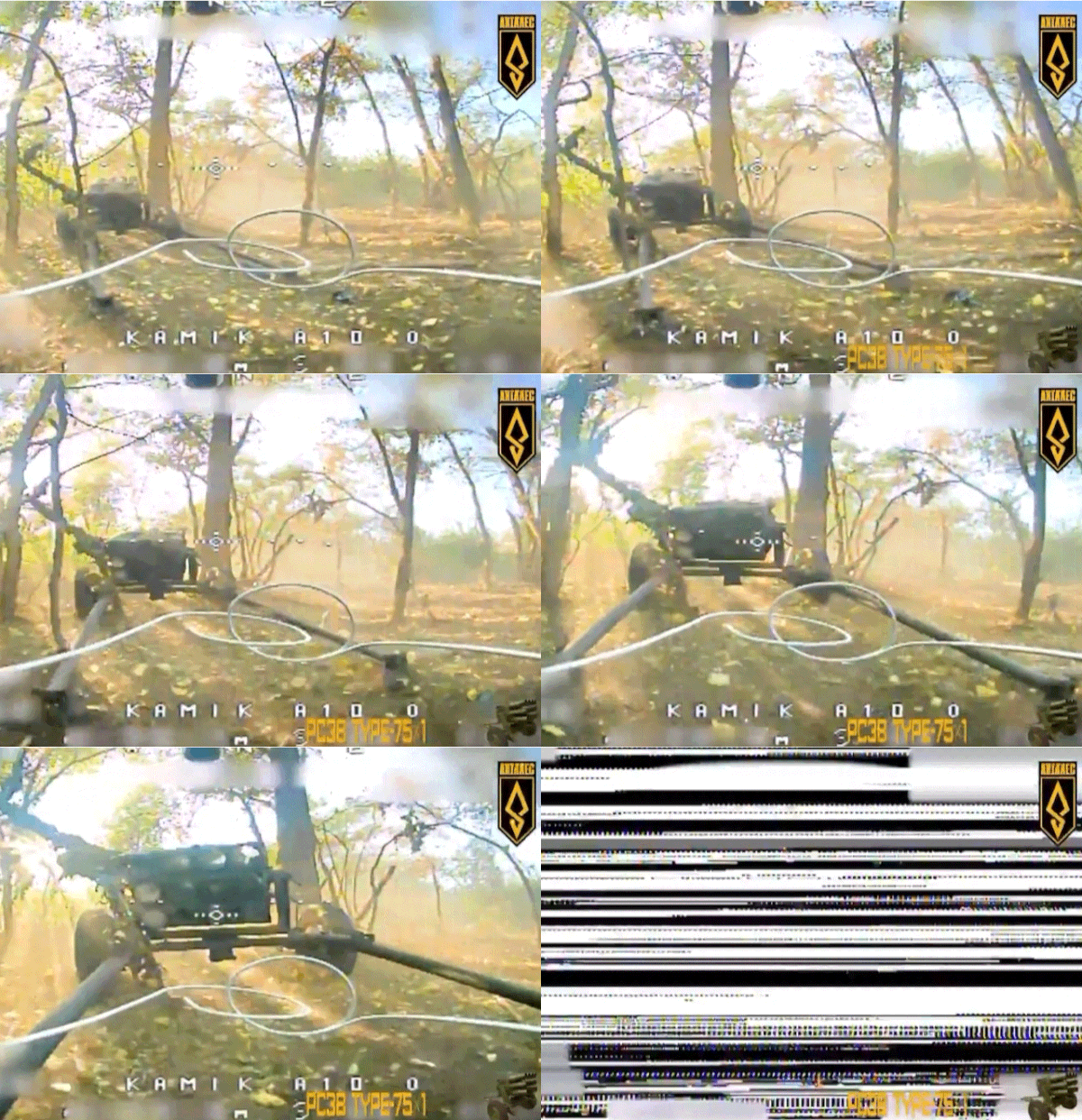
Recent footage showing the destruction of North Korean-supplied rockets to Russia by Ukrainian drone attacks has emerged, highlighting the limitations of North Korean weaponry in modern warfare where drones play a crucial role.
On July 26, social media platform X (formerly Twitter) saw widespread circulation of a first-person view (FPV) drone video released by Ukraine’s Achilles Brigade, a specialized drone unit, on July 18.
The video captures an FPV drone executing a kamikaze attack on a North Korean-made 107mm Type 75 Multiple Rocket Launcher System (MRLS). Moments before impact, at least four rockets can be seen in the twelve-tube towed launcher. Notably, no personnel are observed monitoring the launcher during the drone’s approach.
The Ukrainian National Guard reported on July 12 that they had successfully neutralized another North Korean MRLS, sharing footage of munitions being dropped onto the launcher.
The Type 75 MRLS has frequently been observed on Russian frontlines and training grounds in recent months. This system is an upgraded variant of the Chinese Type 63, which itself was modeled after the Soviet BM-14.
Defense Express, a Ukrainian military news outlet, noted that this rocket has seldom been deployed outside the Korean Peninsula, adding that Russia’s possession of the Type 75 MRLS indicates an intensification of military cooperation between Moscow and Pyongyang.
Furthermore, the 240mm M1991 multiple rocket launcher, a cornerstone of North Korea’s conventional arsenal, sustained severe damage from a Ukrainian drone strike last month. The attack detonated a rear-mounted shell, causing it to penetrate the crew compartment.
North Korea claimed last year to have extended the M1991’s range to 80 kilometers (about 50 miles). This frontline weapon system, capable of targeting Seoul, exemplifies how even North Korea’s most touted armaments are now vulnerable to drone warfare.
A common vulnerability among these systems is that their loaded rockets are entirely exposed, making them prime targets for drone attacks. This sharply contrasts with the U.S. High Mobility Artillery Rocket System (HIMARS), which employs containerized, sealed munitions offering enhanced protection against explosions.
Business Insider, a U.S. media outlet, observed that while North Korea’s recently unveiled rockets appear to have some additional protective features, most seem to be merely scaled-up versions of existing designs. The report emphasized that even North Korea’s new rocket systems appear to lack adequate munition protection, leaving them susceptible to potentially devastating attacks from low-cost unmanned aerial vehicles.