

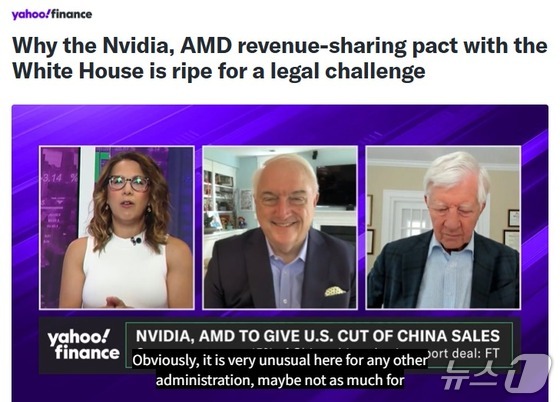
Yahoo Finance reported on Monday that President Donald Trump’s decision to allow Nvidia and AMD to export artificial intelligence (AI)-specific chips to China while reclaiming 15% of the sales revenue is clearly unconstitutional. If these companies file a lawsuit, the U.S. government would undoubtedly lose the case.
The previous day, Trump announced that Nvidia and AMD could resume exports to China in exchange for surrendering 15% of their profits. He did not specify how these funds would be used.
Legal experts unanimously agree that neither the President nor Congress has the authority to impose taxes on exported goods.
Article I, Section 9 of the U.S. Constitution, known as the Export Clause, explicitly states that no tax or duty shall be laid on articles exported from any State.
International trade attorney Douglas Jacobson commented that Trump’s statement about reclaiming 15% of the profits is essentially a tax on exports. He added that the Constitution clearly prohibits any taxes on exported goods.
There is already legal precedent for this issue. In 1998, the U.S. Supreme Court ruled against any form of fees imposed on exported goods.
At that time, the Bill Clinton administration attempted to impose a 0.125% tax on exported goods under the guise of port maintenance fees. The government argued it was not a tax but a port usage fee.
However, the Supreme Court ruled that such fees effectively constituted a tax and deemed them unconstitutional.
Nvidia and AMD are not expected to file a lawsuit against the U.S. government, as paying 15% of their profits would allow them to resume exports to China.
Nevertheless, Yahoo Finance predicts that other entities are likely to file lawsuits.
The financial news outlet suggests that shareholders of Nvidia and AMD are highly likely to initiate a class-action lawsuit. The government’s decision to take 15% of profits from China sales will inevitably reduce the companies’ margins, directly contradicting shareholder interests.
Jacobson anticipates that shareholders will file a class-action lawsuit, citing negative impacts on stock prices, and if they do, they have a 100% chance of winning.