

The clause on eliminating nuclear weapons, followed by chemical and biological weapons, is very welcome. Records from inter-Korean talks confirm that North Korea had previously responded positively to the removal of nuclear and other weapons of mass destruction, pressuring our side. This stands in sharp contrast to North Korea’s recent obsession with its status as an irreversible nuclear power.
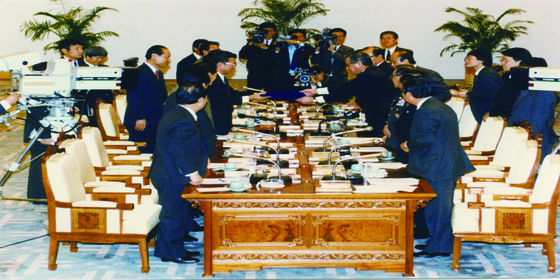
According to the South-North Dialogue Document released by the Ministry of Unification on Tuesday, during the first preliminary high-level talks held on November 11, 1991, at the Conference Row in the northern part of Panmunjom, North Korea strongly agreed to eliminate its nuclear and chemical weapons. This agreement was based on the understanding that the removal of U.S. nuclear weapons from South Korea was implied in the Declaration for a Nuclear-Free Korean Peninsula.
Just three days earlier, on November 8, 1991, Roh Tae-woo had publicly declared the Declaration for a Nuclear-Free Korean Peninsula, which included the principle of not manufacturing, possessing, storing, deploying, or using nuclear weapons. South Korea had previously adhered to the U.S. policy of neither confirm nor deny (NCND) regarding the presence of U.S. nuclear weapons; however, it abandoned that stance and broadened the scope of denuclearization to cover the entire Korean Peninsula.
During these preliminary talks, the North Korean representative commented that former President Roh’s declaration seemed somewhat premature. They argued that since South Korea follows the U.S. NCND policy, it was unclear whether the proposal included the removal of U.S. nuclear weapons from South Korea.
The North’s representative stated that the declaration doesn’t address the issue of nuclear weapons being brought in and there is no plan for handling their importation. Further noting that it does not prohibit nuclear weapons from entering their territory by air, land, or sea. They further noted that there is also no mention of how to deal with foreign nuclear weapons.
They added that when it comes to denuclearizing the Korean Peninsula, there is no international guarantee. At that time, North Korea had also been a strong advocate for the denuclearization of the Korean Peninsula. In 1986, Kim Jong Il declared at the Supreme People’s Assembly that the government of the Republic will make every effort to withdraw nuclear weapons from South Korea and turn the Korean Peninsula into a nuclear-free and peaceful zone.
The South’s representative emphasized that everything occurring within the territory is taken into account in this discussion, as stated in the President’s declaration. They continued that it is not about eliminating something that does not exist; it is about preventing the possession of nuclear weapons that do not exist, and proposed eliminating the capability to manufacture nuclear weapons.
According to the keynote speech from the fifth round of inter-Korean high-level talks, North Korea stated that in the country, where peace has not yet been established and the North and South remain in a state of military confrontation, neither side can live comfortably for even a day with nuclear weapons on the territory. They expressed their support for denuclearization, asserting that their proposal to eliminate all these sources of anxiety was justified a million times over.
Joint Declaration for a Nuclear-Free Korean Peninsula’ Used as Leverage; Non-Aggression Pact Aimed at U.S. Troop Withdrawal
The two sides continued discussions on the unresolved nuclear issue from the fifth round of talks, holding three meetings at Panmunjom starting December 26, 1991. They adopted the Joint Declaration for a Nuclear-Free Korean Peninsula on the final day, December 31.
However, North Korea later used the joint declaration to attempt to block the deployment of U.S. strategic assets capable of carrying nuclear weapons to the Korean Peninsula, including bombers and submarines. They also demanded inspections of all U.S. military bases and nuclear power plants in South Korea. Concerned about a potential security vacuum, the Roh administration rejected these demands, effectively rendering the joint declaration on denuclearization null and void.
Additionally, during the fifth round of talks, the parties disagreed on the Non-Aggression clause of the Agreement on Reconciliation, Non-Aggression, and Exchange and Cooperation between North and South (the Basic Agreement). North Korea emphasized the need for prior military disarmament, while South Korea stressed the importance of building military trust first. Ultimately, on December 13, 1991, the final day of the fifth high-level inter-Korean talks, they agreed to adopt a dual approach that combined both elements.
It can be inferred that North Korea’s decision to adopt the Non-Aggression Clause was aimed at facilitating the withdrawal of U.S. troops from South Korea. According to the records in Volume 4 of the document collection, the North’s representative argued that if we adopt the non-aggression declaration, it will lead to disarmament between the North and the South, and once it disarms, U.S. troops will inevitably have to withdraw from South Korea.