

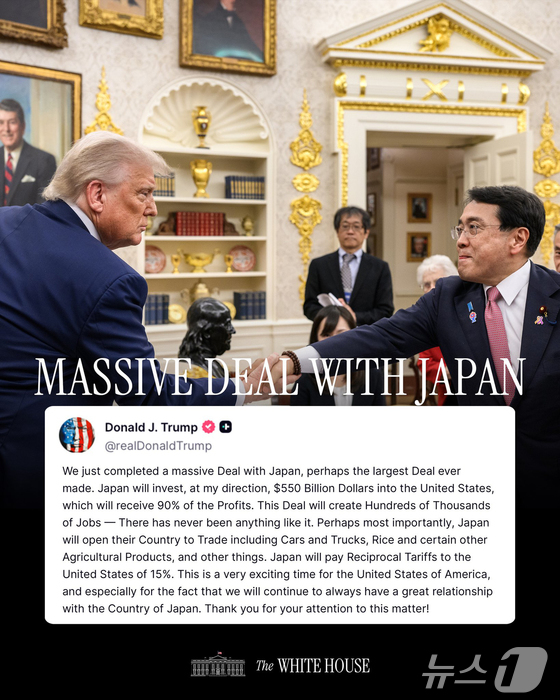
On Thursday, U.S. President Donald Trump signed an executive order detailing the implementation of a trade agreement with Japan.
As a result, tariffs on Japanese automobiles are expected to be reduced from 27.5% to 15%, in line with the agreement reached by both countries on July 22. This development could significantly impact the competitiveness of South Korean cars in the U.S. market, which still face a 25% tariff despite the U.S.-Korea trade agreement.
The White House released the executive order titled “Implementation of the U.S.-Japan Agreement” on the same day.
In the order, Trump specified that the U.S. will impose a standard 15% tariff on nearly all imports from Japan, while applying separate item-specific tariffs on automobiles, auto parts, aerospace products, generic pharmaceuticals, and natural resources not produced domestically.
Notably, the order mandates that the revised tariff schedule for the 15% duty on Japanese cars and auto parts be published in the Federal Register within seven days. Japan’s Kyodo News reported that this new tariff could take effect as early as next week.
Following the trade agreement, Japan had been pressing the U.S. to expedite the reduction of the 27.5% car tariff (a 2.5% base plus a 25% item-specific rate) to 15% through a separate executive order, as the initial adjustment only addressed mutual tariffs.
If Japanese car tariffs drop to 15% next week as anticipated, it will create a 10 percentage point gap with South Korean vehicles, which remain subject to a 25% tariff, potentially putting them at a significant price disadvantage.
On July 30, South Korea pledged 350 billion USD in U.S. investments and agreed to purchase 100 billion USD worth of American LNG, while also committing to lower mutual tariffs, including those on cars and auto parts, to 15%.
Although mutual tariffs have been adjusted for various countries, the item-specific auto tariffs remain unchanged, leaving EU and South Korean vehicles subject to a 25% duty (27.5% for the EU, including the existing 2.5%) instead of the agreed-upon 15%.
On July 22, the U.S. and Japan reached a trade agreement in which Japan promised 550 billion USD in U.S. investments in exchange for lowering mutual tariffs and duties on cars and auto parts to 15%.
The executive order also amended the mutual 15% tariff to apply only to items not already subject to a 15% or higher duty, rather than imposing an additional 15% on all Japanese products.
This 15% mutual tariff will retroactively apply to Japanese products imported for consumption or released from customs warehouses after August 7.
Initially, Japan claimed it received exemptions similar to those granted to the EU; however, Trump’s executive order in early August specified a uniform additional 15% tariff, sparking controversy.
The order also empowers the Commerce Secretary to reduce tariffs to 0% on Japanese generic drugs, potentially their raw materials and precursors, and certain natural resources.
In the order, Trump emphasized Japan’s unprecedented 550 billion USD investment commitment, stating it would create hundreds of thousands of jobs, expand manufacturing, and ensure long-term U.S. prosperity.
He added that Japan would provide significant market access opportunities for U.S. manufacturers, as well as for the aerospace, agriculture, food, energy, automotive, and industrial sectors.
Trump noted that Japan is swiftly implementing plans to increase U.S. rice purchases by 75% within the quota system and to buy 8 billion USD annually in U.S. agricultural and other products, including corn, soybeans, fertilizers, and bioethanol.