

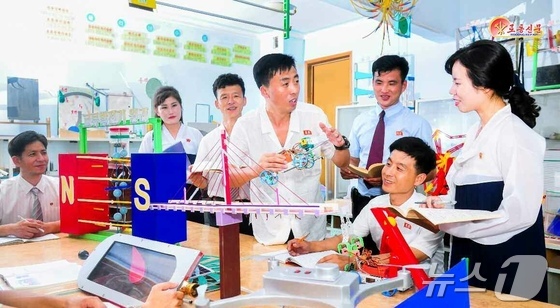
North Korea’s education system is undergoing significant changes. Following General Secretary Kim Jong Un’s emphasis on education as the nation’s top priority at the end of last year, the Education Structure Innovation plan announced during a June plenary meeting appears to be taking shape on the ground.
The September issue of Kumsu Kang San, a monthly magazine aimed at foreign audiences, reported that the Child Intelligence Development Technology Exchange Center at Pyongyang College of Education has been researching and implementing new educational methods to enhance the intellectual abilities of preschool and elementary school students.
Specifically, in line with global educational trends, they have introduced early foreign language education, cognitive arithmetic techniques, and robotics education. These approaches are now widely incorporated into extracurricular activities at many kindergartens and elementary schools, aiming to improve children’s cognitive skills.
The early foreign language education program, for instance, begins in first grade, teaching listening, speaking, and writing skills. By the end of the school year, students can engage in basic conversations and are prepared to start learning a second foreign language. This method has reportedly been well received by students, teachers, and parents alike.
Educational technologies combining mathematics and English have also been introduced in various educational units. For first and second graders, the focus is on developing overall intelligence, while third through fifth graders are taught to cultivate critical thinking and inquiry skills, preparing them for secondary education.
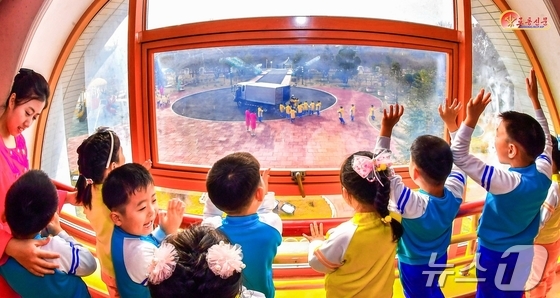
The rapid implementation of these diverse teaching methods, including early foreign language education, appears to be a direct result of Kim’s emphasis on the importance of education ideology. The Rodong Sinmun, the official newspaper of the Workers’ Party, reported that in commemoration of the 48th Education Day (September 5), efforts are underway to improve the education structure. These improvements aim to provide students with more advanced and practical education, establishing a solid foundation for elevating the overall education level in the country.
North Korea’s Education Day marks the anniversary of Kim Il Sung’s 1977 announcement of the Thesis on Socialist Education.
The newspaper noted that the Ministry of Education is preparing to implement a new teaching management system in key universities and teacher training institutions. It is also working on executing the second phase of the 12-year mandatory education program in the general education sector.
Furthermore, a newly developed curriculum for the second phase of the 12-year mandatory education program will allow high school students to choose educational pathways tailored to their individual interests starting from the next academic year.
This year, North Korea piloted elective courses in liberal arts, sciences, arts, physical education, and technology at select high schools in Songrim City, Hwachang County, and Jeongpyeong County. Schools are reportedly developing and implementing a new integrated teaching management system aligned with this educational framework, focusing on enhancing teacher capabilities and establishing specialized teaching units.
In July, the Rodong Sinmun reported that educational institutions are advancing efforts to innovate the education structure. Universities are consolidating departments and creating new programs to adopt a new teaching management system in key universities and teacher training colleges starting from the upcoming academic year.
The newspaper emphasized the need to enhance undergraduate and graduate education while introducing programs in cutting-edge fields like artificial intelligence (AI). This comprehensive reform of all components of the education system is deemed essential for nurturing competent individuals who can meet the demands of the times and contribute practically to society.
Lastly, the importance of revising the education structure to accurately design and implement elective courses in various fields was highlighted. These changes aim to take into account local economic geography, students’ talents and characteristics, as well as existing teacher capabilities and educational conditions.