

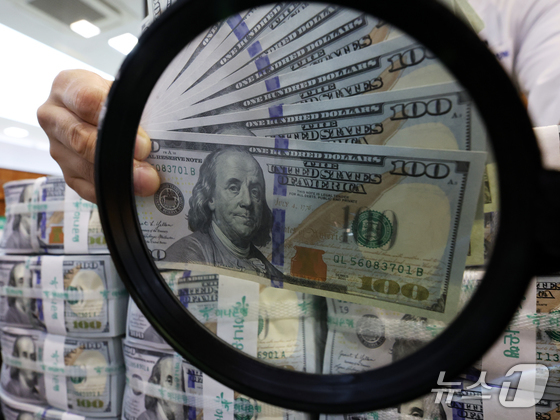
A study reveals that the dollar’s hegemonic structure can magnify the impact of financial instability or interest rate hikes on the South Korean economy by up to threefold. Experts argue that urgent action is needed to bolster the Korean won’s competitiveness by enhancing the appeal of government bond investments and transitioning export settlements to the won.
The Bank of Korea released a report on Monday titled, Global Spillover Effects of Dollar Hegemony and U.S.-Origin Shocks, which used quantitative models to analyze how the dollar’s international financial and trade functions amplify economic shocks to South Korea.
Son Min-kyu, head of the Bank of Korea’s economic modeling department and the report’s author, noted that without the dollar channel, the decline in domestic production due to financial risk shocks would be reduced by more than two-thirds. This suggests that dollar dependence triples the impact of domestic economic shocks.
The report also challenged the conventional wisdom that a strong dollar improves South Korea’s export competitiveness and trade balance.
Son explained that since most of the exports are denominated in dollars, an increase in the South Korean won exchange rate actually raises prices in export markets, negatively impacting the exports. Further noting that iIf exports were settled in South Korean won, they estimate the reduction in domestic production would decrease by about 25%.
This implies that the long-held belief that a strong dollar benefits South Korean exports is no longer valid. The dominant factor appears to be the Dollar Pricing effect, where a strong dollar increases export prices for Korean companies.
The negative effects of dollar hegemony were also evident in the impact of U.S. interest rate hikes. When dollar-based financial and trade channels exist in the South Korean economy, domestic consumption and investment sharply decline during interest rate increases. However, without these channels, the reduction in domestic production would decrease by 30%.
The report also offered policy recommendations. Son predicted that if the attractiveness of Korean government bonds increases due to inclusion in the World Government Bond Index (WGBI), the domestic spillover effects of U.S. financial shocks amplified through the dollar channel could be somewhat mitigated.
He also advised expanding settlements in South Korean won. Son stated that it needs to consistently promote the internationalization of the South Korean won through cooperation with other Asian countries. That this will help reduce the impact of dollar fluctuations on the imports and exports through trade channels.
Additionally, he suggested that due to the potential proliferation of dollar stablecoins, South Korea should prepare for the global ripple effects of dollar value fluctuations, as changes in the dollar’s international status could significantly impact the domestic economy.