

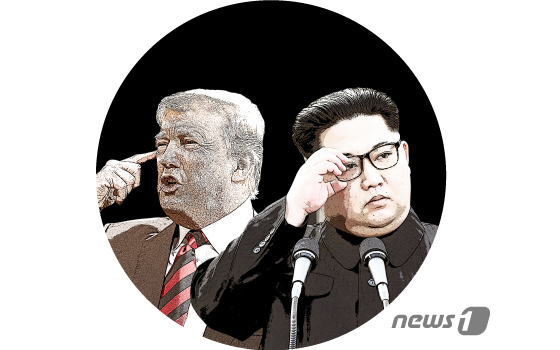
President Donald Trump failed to mention North Korea even once during his address at the United Nations (UN) General Assembly. This omission starkly contrasts with recent remarks by Workers’ Party General Secretary Kim Jong Un, who warmly recalled having good memories with Trump. The reasons behind Trump’s silence have sparked varying analyses among experts.
On Tuesday, Trump delivered a keynote speech at the 80th session of the UN General Assembly in New York, proudly recounting his diplomatic achievements and claiming that he had ended seven wars within seven months of taking office.
Trump specifically enumerated conflicts he purportedly resolved, including those between Cambodia and Thailand, Kosovo and Serbia, Congo and Rwanda, Pakistan and India, Israel and Iran, Egypt and Ethiopia, and Armenia and Azerbaijan. He grumbled that the UN had offered no assistance in these efforts.
The President also vented his frustration over the stalled negotiations to end the Ukraine war, criticizing both Russia and European nations. Furthermore, he rebuked India and China for purchasing Russian oil. Trump touched on nearly every major international issue he deems significant.
However, throughout his hour-long speech, Trump notably refrained from mentioning North Korea or the Korean Peninsula. He remained silent on U.S.-South Korea relations and regional concerns, with South Korea receiving only a fleeting mention amid his list of nations involved in tariff and trade negotiations.
During his first term, Trump addressed the UN General Assembly four times between 2017 and 2020. Except for the 2020 virtual address due to COVID-19, he consistently made his stance on North Korea clear.
In his inaugural UN speech in September 2017, Trump infamously dubbed Kim Rocket Man, asserting that he was on a suicide mission for himself and his regime. Trump strongly condemned the North Korean government, even hinting at the prospect of total destruction as part of his pressure campaign.
Following the dramatic shift in dynamics on the Korean Peninsula and the historic Singapore summit in June 2018, Trump’s September UN address that year took on a different tone. He described the meeting as very productive, highlighting North Korea’s cessation of nuclear and missile tests as a key achievement, and even expressed gratitude toward Kim.
In September 2019, after the collapse of the Hanoi summit, Trump discussed North Korea’s potential, asserting that to realize this potential, denuclearization is necessary, which indicated a continued interest in dialogue.
Analysts initially expected Trump to extend an olive branch to North Korea during this UN Assembly, especially since he had repeatedly emphasized his friendship with Kim Jong Un since before his second term and shown a keen interest in U.S.-North Korea dialogue.
Kim’s recent address at the 14th Supreme People’s Assembly on September 20-21, which conveyed conciliatory messages, further fueled speculation that Trump might reciprocate during his UN speech.
In his speech, Kim stated that if the U.S. discards its unrealistic obsession with denuclearization and seeks true peaceful coexistence with them based on reality, they have no reason to turn our backs on the U.S. He also noted that personally, he still holds good memories of the current U.S. President Trump, marking his first comment on a potential U.S.-North Korea summit since Trump’s re-election.
Trump’s omission of North Korea has spurred conflicting interpretations in diplomatic circles.
Some analysts suggest that Trump prioritized showcasing his achievements and addressing pressing issues over discussing North Korea—a matter that remains a work in progress.
Others speculate that, given North Korea’s recent bolstering of its anti-U.S. alliance with China and Russia, coupled with the challenges surrounding denuclearization, Trump may have found it more strategic to align with South Korea and Japan at this time.
A few cautiously hint at the possibility of behind-the-scenes U.S.-North Korea contact. They propose that North Korea might have relayed Kim’s message to the U.S., or that the U.S. may have communicated in some way with North Korea, prompting Trump’s measured approach.
North Korea sent Deputy Foreign Minister Kim Sun-kyung to the UN General Assembly, marking the first high-level North Korean attendance in seven years. This move aligns with Kim’s recent participation in China’s Victory Day celebrations, indicating a desire to expand multilateral diplomatic engagement. The U.S. government is closely monitoring potential back-channel communications between the two nations.
The possibility of U.S.-North Korea contact may become clearer following North Korea’s UN address on September 29. If the North Korean speaker refrains from harsh criticism of the U.S. or adopts a more measured tone, it could signal that ongoing diplomatic communications are in play.