

North Korea has become one of the three countries capable of striking the U.S. mainland. South Korea must confront this reality with clarity and sobriety.
It is estimated that North Korea possesses up to 2,000 kilograms (about 4,400 pounds) of highly enriched uranium (HEU) that could be used in nuclear weapons production.
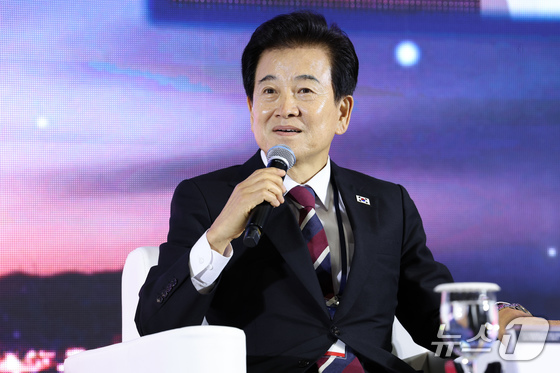
Recently, Unification Minister Chung Dong-young made some startling remarks regarding North Korea’s nuclear status. It is highly unusual for the Minister of Unification—whose role is to craft policies for peace and reunification and to foster inter-Korean dialogue—to frequently discuss the reality of North Korea’s nuclear capabilities.
As these comments persist, some critics argue that Minister Chung is effectively recognizing North Korea as a nuclear power, thereby crossing a diplomatic red line.
A government official explained that Minister Chung’s bold statements are intended to increase awareness of the North Korean nuclear issue and to urge President Donald Trump to take swift action regarding the Korean Peninsula.
However, this rapid escalation raises concerns about the anxiety it could inflict on citizens. Some observers note that the current administration, led by Lee Jae Myung, appears to regard North Korea as the strongest it has ever been compared to previous South Korean government assessments.
While the government hopes that President Trump will quickly emerge as a Peacemaker, his attention seems to be divided among various global issues. The Ukraine-Russia war, Middle East tensions, trade negotiations, and immigration challenges all appear to take precedence over the situation on the Korean Peninsula.
Notably, during his recent address at the United Nations (UN) General Assembly on September 23, President Trump did not mention North Korea even once. This silence suggests a sentiment that if North Korea isn’t acting, there is no reason for the U.S. to intervene, reflecting the challenging diplomatic reality faced by South Korea.
In this context, the South Korean government seems to be the most vocal about North Korea’s nuclear capabilities. At a recent Korea Investment Summit in New York on September 25, President Lee stated that North Korea appears to have secured enough nuclear weapons to ensure regime survival.
He also noted that North Korea is on the verge of developing intercontinental ballistic missiles (ICBMs) capable of reaching the U.S. mainland, with only the refinement of re-entry technology remaining. Lee warned that without intervention, North Korea could expand its nuclear arsenal by 15 to 20 bombs and possibly export nuclear weapons.
The government’s proactive approach in raising these concerns can be seen as an effort to draw international attention to the North Korean nuclear threat. As a key stakeholder in Korean Peninsula affairs, South Korea is taking the initiative to alert the global community to the gravity of North Korea’s nuclear advancements.
However, the international response to these efforts appears to be tepid, suggesting a potential disconnect between South Korea’s sense of urgency and global priorities.
Ironically, the party that might ultimately be most satisfied with this situation could be North Korea itself. Pyongyang’s long-held goal of being recognized as a nuclear power is inadvertently being promoted by its adversary, South Korea.
This scenario presents a complex picture of South Korean diplomacy. Unable to directly influence inter-Korean relations, Seoul finds itself in the position of having to advertise North Korea’s nuclear capabilities to the international community—particularly the U.S.—in the hopes of catalyzing a shift in the dynamics on the Peninsula. Moving forward, it is crucial for South Korea to navigate this delicate situation with diplomatic finesse, maintaining national dignity while clearly communicating its concerns without overstepping diplomatic boundaries.