

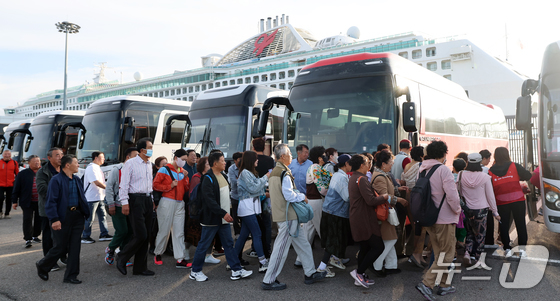
On the first day of visa-free entry, six Chinese tourists who disembarked from the cruise ship Dream at Incheon Port have gone missing, and their whereabouts remain unknown.
A Ministry of Justice official stated on Tuesday that it has deployed a task force to track their movements, but we haven’t apprehended anyone yet. However, it has identified the nationality, age, and gender of the six missing individuals.
The Dream cruise ship, which departed from Tianjin, China, arrived at Incheon Port on September 29 with 2,189 passengers. However, when it set sail again at 10:00 p.m. on the same day, only 2,183 passengers were on board, indicating that six individuals did not return after disembarking.
The passengers aboard the Dream entered South Korea under the Tourist Landing Permission System, which allows eligible tourists to disembark for up to three days without a visa.
While the maximum stay is three days, this special provision for short-term tourism requires passengers to reboard before departure, even if their stay is shorter. Anyone failing to return by the designated time is considered an illegal resident.
The six missing Chinese individuals have now exceeded the maximum permitted landing period by more than two weeks. The authorities’ inability to track their movements has raised serious concerns about gaps in national security.
The issue extends beyond these six individuals. There are growing fears that more foreigners might exploit loopholes in the residency system to stay illegally. According to the Ministry of Justice, as of August, there were 230,643 identified illegal residents in South Korea, with Chinese nationals (43,521 or 18.9%) forming the second-largest group after Thais (117,297).
Article 46 of the Immigration Control Act permits the forced deportation of foreigners who remain in South Korea without proper status or exceed their permitted stay. However, this provision is essentially toothless due to the authorities’ inability to monitor the movements of illegal residents.
Representative Jeong Yeon-wook of the People Power Party told News1 that the government’s focus on attracting tourists has led to a neglect of public safety and border control, heightening public anxiety. As the number of illegal residents rises, so does the potential for crime. The government must prioritize public safety and take appropriate measures.
Despite the increase in illegal stays exploiting domestic system loopholes, the government has shown no signs of addressing the issue. In fact, they plan to implement a visa-free entry system for Chinese group tourists until June of next year in addition to the existing Tourist Landing Permission System.
An Incheon Port Authority official clarified that the introduction of visa-free entry for Chinese group tourists will not eliminate or affect the existing Tourist Landing Permission System. Visa-free entry will apply to air travel, while the Tourist Landing Permission System will continue to facilitate the arrival of Chinese tourists by ship.
The government projects that about 1 million additional Chinese tourists will visit South Korea during the visa-free period in the first half of next year.