U.S. security experts suggested on Tuesday that President Donald Trump’s visit to South Korea for the Asia-Pacific Economic Cooperation (APEC) summit later this month could still potentially include a meeting with North Korea’s General Secretary of the Workers’ Party, Kim Jong Un.
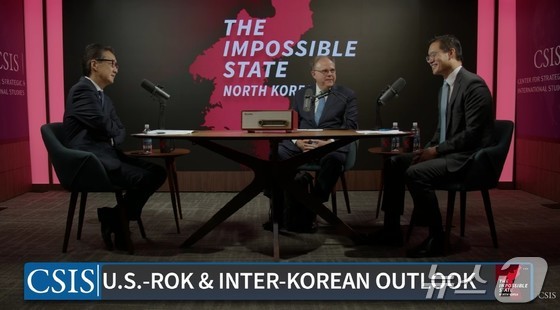
During a podcast discussion hosted by the Center for Strategic and International Studies (CSIS), a prominent U.S. think tank, senior advisor Sydney Seiler responded to a query about Trump possibly making a brief trip to the Demilitarized Zone (DMZ) next week, stating that he believes there’s a chance it could happen.
Seiler elaborated that even if this meeting doesn’t materialize, it’s not solely because North Korea’s approach to denuclearization is diametrically opposed to that of the U.S. Both parties have considerable flexibility to adjust their rhetoric and approaches.
He added that if the encounter is limited to a brief exchange of pleasantries like “How have you been? Good to see you”, he believes they can easily overcome their differences on denuclearization objectives. Subsequently, working-level teams can continue addressing these issues.
Victor Cha, the Korea Chair at CSIS and podcast host, argued that he wouldn’t rule out the possibility that Trump might say in Washington, D.C., Denuclearization is the goal and policy, and then at the DMZ declare, Kim, he’s a nuclear power. Such a contradictory approach is entirely plausible.
Cha explained that given the multitude of global issues the U.S. currently faces, a brief interaction of this nature shouldn’t necessarily be viewed negatively. It’s about gauging the situation and maintaining open lines of communication.
Andrew Yeo, a Korea Chair at the Brookings Institution, expressed skepticism about the likelihood of a meeting, stating that judging by the schedule alone, he’d say the chances are quite slim. President Trump will only be there for a day or two at most. He added that moreover, the Trump-Xi Jinping meeting is likely to consume the bulk of U.S. government resources and attention.
Yeo noted that it seems highly improbable, but with Trump, you can never completely rule it out. Remember, he orchestrated the 2019 DMZ visit with just a single tweet. He concluded that while he can’t say it’s impossible, he believes the probability is extremely low.
Regarding the outlook for follow-up negotiations on the U.S.-South Korea trade agreement, experts suggested the possibility of reaching a partial agreement in specific sectors, such as shipbuilding, concerning the contentious 350 billion USD investment before APEC.
Yeo explained that the crux of the matter is how to structure the 350 billion USD investment that South Korea promised to the U.S. They’re still working out the details. He added that Trump claimed last week that South Korea agreed to an upfront payment, but that’s simply not feasible for South Korea.
He continued that South Korea likely envisioned fulfilling this substantial investment over the long term, given their broad range of cooperative industries like shipbuilding and semiconductors. Trump, not one for details, threw out a big number—be it 350 billion USD or 250 billion USD—and now it’s become a sticking point.
Yeo noted that Trump is now asking, Where’s the money? How and when will it be delivered? That’s where negotiations have hit a snag.
Yeo suggested that, in his view, an upfront payment of 350 billion USD is off the table. It needs to focus on timing. A Japanese-style model has been proposed, which involves identifying key investments, finalizing deals, and setting execution timelines for each project, rather than a lump sum of 350 billion USD.
He added that, however, South Korea seems hesitant to commit even to this approach. So, this is largely speculative, and it’s hard to predict the likelihood of an agreement definitively. South Korea will probably want to highlight areas where they’ve made more progress, such as security issues.
Seiler commented that both sides are eager for a deal, so there must be a mutually beneficial solution somewhere. While it won’t be straightforward, the positive statements from both Washington, D.C., and Seoul last week are encouraging. At the very least, he doesn’t anticipate these negotiations derailing or undermining the summit or APEC itself.
Yeo remarked that for instance, if South Korea commits to a specific investment in shipbuilding and presents a funding plan, securing even one concrete, tangible project could significantly advance negotiations. Even without all the details ironed out, having a visible achievement to showcase at APEC could serve as a crucial starting point.