

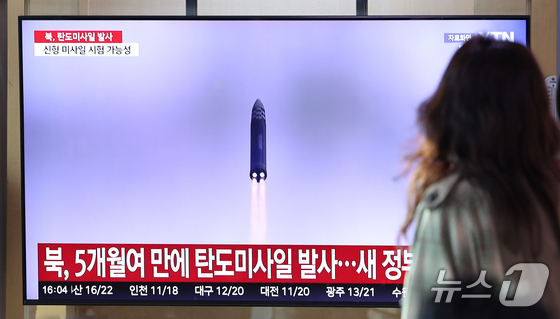
On October 22, North Korea launched its first ballistic missile since the inauguration of President Lee Jae Myung’s government, escalating tensions on the Korean Peninsula. In response, defense experts are urging South Korea to expand and enhance its ballistic missile interception capabilities.
A report released on Wednesday by the Korea Institute for Defense Analysis (KIDA), titled, Plans for Advancing Ballistic Missile Interception Training, and authored by Research Fellow Yoo Seung-kun, reveals that current domestic missile defense drills primarily focus on procedural exercises without live-fire components.
While the Joint Chiefs of Staff conducted a simulated interception exercise in November 2024 using the Air Force’s Missile Defense Command, Cheongung-II, and Patriot surface-to-air missiles, these live-fire drills are still in their infancy, having only begun last year.
Yoo argues that given North Korea’s provocations, the need for operational readiness, and the importance of maintaining a credible deterrent, South Korea must prioritize realistic missile defense training.
He suggests that in the short term, utilizing American-made Patriot PAC-3 and South Korean Cheongung-II systems for lower-tier defense, along with long-range surface-to-air missile (L-SAM) test firings for upper-tier defense, would suffice. However, Yoo emphasizes that long-term training should evolve to address the entire kill chain, from ballistic missile detection to interception.
The report cites active live-fire exercises conducted by U.S. allies as examples to follow. These include Europe’s Formidable Shield, aimed at countering Russian threats, and Israel’s Jupiter Cobra, designed to deter Iranian aggression, both of which involve small-scale live-fire drills in cooperation with U.S. forces.
Yoo recommends integrating condition-based maintenance (CBM) operational simulation models, Air Force intercept missile simulators, and practical ballistic missile interception training. He also advocates for scientific combat training that incorporates these systems, along with joint exercises involving all military branches under the Joint Chiefs of Staff to enhance overall readiness.