

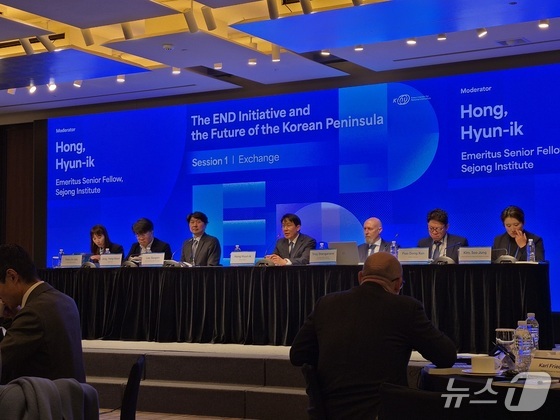
A new proposal has emerged suggesting that restoring the June 12 Singapore Joint Statement and initiating exchanges in military and humanitarian sectors could serve as a catalyst for improving U.S.-North Korea relations and fostering dialogue.
Troy Stangarone, a non-resident fellow at the Carnegie Mellon Institute for Strategy and Technology, presented this idea on Monday during an international conference titled, The Lee Jae Myung Administration’s E·N·D Initiative (Exchange, Normalization of Relations, Denuclearization) and the Future of the Korean Peninsula, hosted by the Korea Institute for National Unification (KINU) at the Westin Chosun Hotel in Seoul.
Stangarone cited the case of Otto Warmbier, the American student who was detained by North Korean authorities, returned to the U.S. in a comatose state, and subsequently died, to underscore that merely resuming civilian exchanges, such as tourism, would be insufficient to improve U.S.-North Korea relations.
Instead, Stangarone proposed the SMART Initiative. This framework calls for exchanges to resume based on restoring the Singapore Joint Statement (S), military-to-military contacts (M), agricultural exchanges (A), reunions of Korean American separated families (R), and North Korea’s tuberculosis eradication efforts (T).
He explained that while military contacts are sensitive issues for both sides, they can help alleviate suspicions over time. Stangarone emphasized that restoring family ties, particularly through reunions of separated families, will play a crucial role in building a new relationship between the U.S. and North Korea.
Stangarone drew parallels to historical examples, noting that during the Cold War, East Germans could travel to West Germany for family events, and exchanges occur between China and Taiwan. He argued that changing the current prohibition on family communication and visits between the Koreas would be a key element of an Exchange policy, potentially leading to improved relations for both the U.S. and South Korea.
The researcher also highlighted two promising areas for technological cooperation: agriculture and tuberculosis-related medical exchanges. He advocated for starting with small-scale projects and expanding cooperation if successful.
Lee Sang-shin, head of the Unification Policy Research Division at the KINU, commented that the E·N·D initiative differs from previous administrations’ North Korea policies by allowing for flexible responses without strictly adhering to a logical order of engagement. Lee suggested that this pragmatic policy flexibility could enable novel approaches to North Korea.
Junya Nishino, a professor at Keio University, predicted that from North Korea’s perspective, policies derived from genuine Japan-South Korea cooperation would carry far greater credibility than unilateral measures. Nishino argued that when Japan and South Korea present a united front, North Korea would be unable to exploit divisions or pit one country against the other.
Mason Rich, a professor at Hankuk University of Foreign Studies, contended that while peaceful coexistence between North and South Korea would be positive, there is little evidence to suggest North Korea would respond favorably. Rich posited that a normalized yet hostile coexistence is a more likely scenario.
Professor Rich pointed out that the East-West German case featured less pronounced economic and political disparities compared to those between North and South Korea. He also noted that the UK-Ireland case involved internal conflict rather than inter-state conflict, and emphasized that the relationships between Israel, Egypt, and Jordan do not provide applicable models for the Korean Peninsula.
Rich concluded that the prospects for normalizing inter-Korean relations depend on how normalization is defined in terms of reducing hostility. He added that the extent and sustainability of any normalized inter-Korean relations would be partially influenced by external factors affecting the Korean Peninsula.