

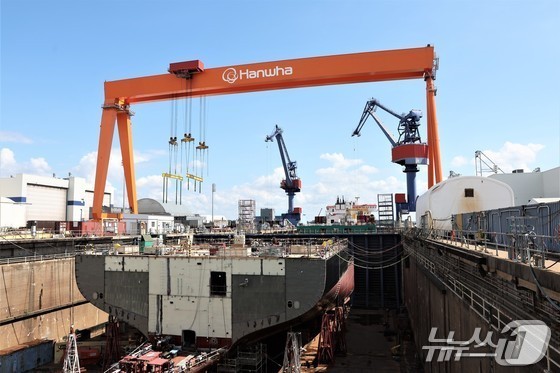
Industry experts in South Korea suggest that building nuclear submarines in the U.S. is a viable option. Hanwha’s planned major investment of 5 billion USD in the Philadelphia shipyard could significantly upgrade infrastructure and allow for the deployment of skilled Korean technicians to fill any expertise gaps.
Analysts in the shipbuilding sector argue that a joint construction approach between South Korea and the U.S. offers numerous advantages. This strategy could revitalize the U.S. shipbuilding industry through local production while enabling South Korea to achieve technological independence. They emphasize that expediting tariff negotiations would be more beneficial for national interests than prolonging debates over construction sites.
Despite President Donald Trump’s assertion that South Korea will construct nuclear submarines at the Philadelphia shipyard, the South Korean government remains committed to domestic production.
U.S. Submarine Construction Capabilities Questioned; Ample Time and MASGA Funds Offer Solutions
Industry sources reported on Tuesday that a primary argument for domestic construction is the current lack of submarine-building infrastructure at the Philadelphia shipyard, which Trump specifically mentioned.
However, Hanwha announced plans in August to invest 5 billion USD to boost annual shipbuilding capacity to 20 vessels and establish a 120,000-square-meter block production facility. This site is reportedly intended for special vessel production, including military ships. Industry experts believe that if Hanwha secures the site as planned, constructing sealed land workspaces and foundations capable of supporting submarine weight could be achieved relatively quickly.
The construction of nuclear submarines requires substantial funding and equipment. Industry analysts suggest that tapping into the recently established 150 billion USD Make American Shipbuilding Great Again (MASGA) fund for the Philadelphia shipyard could significantly reduce initial investment burdens.
The Philadelphia shipyard’s strategic location between General Dynamics Electric Boat and Huntington Ingalls Newport News, both currently building nuclear submarines, is seen as advantageous for expanding submarine production capacity. Hanwha Ocean could deploy its skilled technicians to the Philadelphia shipyard, gradually addressing personnel and supply chain limitations.
Potential for Expedited Defense License Approval Accelerates Nuclear Submarine Acquisition
Given President Trump’s specific mention of the Philadelphia shipyard, there’s a high probability of fast-tracking U.S. defense license approvals. This presents a unique opportunity for the shipyard to engage in U.S. Navy projects. Hanwha Ocean has already initiated the Facility Security Clearance (FCL) process with the U.S. Department of Defense and submitted a Request for Information (RFI) for U.S. Navy project participation.
Utilizing the Philadelphia shipyard would enable South Korean firms to establish a foothold in advanced submarine construction within the United States.
A feasible scenario involves building South Korea’s indigenous nuclear-powered submarines domestically while simultaneously constructing Virginia-class submarines at the Philadelphia shipyard. This approach could rapidly integrate South Korea into the global nuclear submarine industry, paving the way for future export opportunities.
Constructing Virginia-class submarines at the Philadelphia shipyard while accumulating expertise and leveraging South Korean module and block suppliers could enhance the quality of South Korea’s nuclear-powered submarines while mitigating risks.
Domestically, this strategy could foster growth among suppliers in areas such as facilities, design, materials, and modules. Hanwha Ocean’s recent expansion of its consortium with 16 shipyards and suppliers in Busan and Gyeongnam for U.S. Navy maintenance, repair, and overhaul (MRO) projects exemplifies this potential for collaboration.
The political sphere echoes these sentiments. On November 8, Representative Kim Yong-tae of the People Power Party, following a visit to the Philadelphia shipyard, stated that it must reaffirm the principle that American submarines are built in America and Korean submarines in Korea. If South Korean companies can construct nuclear submarines and small modular reactor (SMR) vessels in the U.S., it could catalyze significant advancements in domestic shipbuilding projects.