

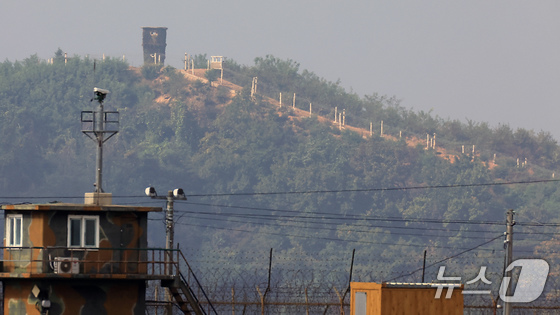
The South Korean government has made a surprising proposal for military talks with North Korea, which has maintained a policy of cutting off dialogue. Although the chances of North Korea joining the negotiations remain slim, analysts suggest the proposal could serve dual purposes: easing military tensions in border areas and underscoring South Korea’s continued commitment to inter-Korean dialogue.
On Monday, Kim Hong Cheol, Director of Policy at the Ministry of National Defense, stated that the South Korean military had formally proposed talks between the military authorities of the two Koreas to discuss establishing a baseline for the Military Demarcation Line (MDL), aimed at preventing accidental clashes and reducing tensions. He noted that the timing and location of the meeting could be arranged through Panmunjom.
The government explained that the proposal is driven by the need to define the MDL baseline clearly. Recently, North Korean forces have been constructing tactical roads and setting up barbed wire fences near the MDL. Some soldiers have repeatedly crossed into South Korean territory, raising ongoing security concerns.
Most experts remain pessimistic about whether North Korea will respond. After adopting its policy of treating the two Koreas as two hostile states, North Korea has openly avoided all contact with the South. In April 2023, Pyongyang cut off all communication channels, shutting down both the Panmunjom line and the East–West military hotlines.
The proposal to establish an MDL baseline is also unlikely to draw North Korea’s interest. Pyongyang has long insisted that only the United States, China, and North Korea are parties to the armistice agreement and may view MDL discussions with South Korea as irrelevant.
From a military perspective, North Korea likely sees little benefit in the talks, as it does not view the South as an immediate existential threat.
Diplomatically, Pyongyang is focused on strengthening ties with China and Russia. Around the time of last month’s APEC summit in Gyeongju, North Korea reportedly dismissed U.S. President Donald Trump’s outreach to Kim Jong Un, effectively declining U.S. engagement efforts.
Professor Kim Dong Yeop from the University of North Korean Studies stated that the proposal is one of several ideas to establish a dialogue platform with North Korea, but assessing its effectiveness is challenging. He added that North Korea’s border demarcation efforts are strategic and political, making it unlikely that a technical discussion alone could resolve the situation.

Despite skepticism, the proposal should not be dismissed as symbolic. With North Korean troops crossing the MDL more than ten times this year, prompting repeated warning shots from South Korean forces, practical measures to reduce tensions are urgently needed.
Moreover, in the context of the Lee Jae Myung administration’s ongoing efforts to ease tensions, such as controlling anti-North Korean leaflet releases, halting loudspeaker broadcasts, and repatriating North Korean residents, the proposal is widely viewed as a signal of the South’s consistent willingness to pursue dialogue.
Professor Kim Yong Hyun of Dongguk University noted that ignoring the rising risks around the MDL could lead to more complex accidental conflicts and stated that the proposal serves as a safety mechanism to prevent such scenarios, while demonstrating South Korea’s readiness for dialogue, regardless of the outcome.
Professor Kim added that the government is fully aware of the situation and is developing its own strategic rationale, recognizing that securing actual talks with North Korea will not be easy.
If inter-Korean military talks materialize, the agenda could expand beyond the MDL issue. Given the administration’s pledge to gradually restore the September 19 military agreement, discussions could again address measures to reduce broader military tensions, including restrictions on border-area training and the restoration of military communication lines. Some analysts believe the talks could eventually develop into ministerial discussions or even leadership summits.
With inter-Korean military communication lines currently cut off, South Korea’s proposal is expected to be delivered through the UN Command–North Korean Army channel. The Ministry of National Defense is also considering additional measures to encourage a meeting if North Korea responds, and some experts believe further government messages may follow.