

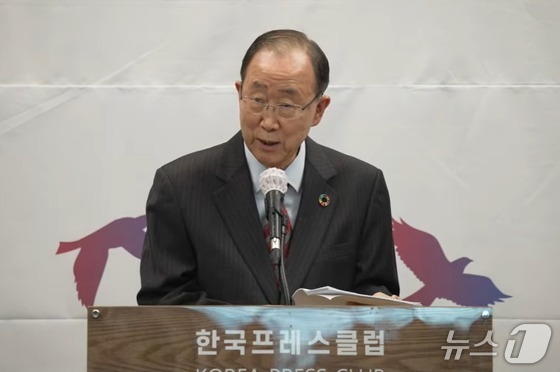
Former UN Secretary-General Ban Ki Moon has emphasized the significant importance of the Lee Jae Myung administration’s decision to co-sponsor the UN General Assembly’s resolution on North Korean human rights.
Ban made this statement during his keynote address at the 20th Anniversary of R2P (Responsibility to Protect) International Conference: North Korean Human Rights and R2P, held at the Seoul Press Center on Tuesday.
He noted that the current government’s involvement as a co-sponsor reflects its recognition of North Korean human rights as a crucial issue tied to universal values.
On December 12, South Korea joined 40 nations, including Japan, France, and Germany, in co-sponsoring the human rights resolution introduced by the UN General Assembly’s Third Committee.
The resolution expresses concern over human rights violations by North Korean authorities and calls for improvements. This move has been seen as somewhat unexpected, given the Lee administration’s previously cautious approach to the sensitive issue of North Korean human rights.
Ban also pointed out that perceptions and policies regarding North Korean human rights in South Korea continue to shift with changes in political leadership, which he described as problematic.
He highlighted the failure to establish the North Korean Human Rights Foundation due to partisan disagreements since the 2016 enactment of the North Korean Human Rights Act. Ban also mentioned the recent downgrading of the department responsible for North Korean human rights within the Ministry of Unification following the new government’s inauguration. He stated that the inconsistency in human rights policies between progressive and conservative administrations in Korea is a significant issue.
Ban further stressed the importance of reassessing the value of human rights and the direction of R2P in today’s world of increasing geopolitical instability and crises.
He cited Russia’s use of its veto power on a UN resolution aimed at protecting its ally Syria, arguing that the UN Security Council needs reform to fulfill its responsibilities effectively in the current global context.
Ban added that he plans to raise these issues again in a speech at the UN Security Council on December 15.
R2P (Responsibility to Protect) is the principle that states have a duty to protect their citizens from genocide, war crimes, ethnic cleansing, and crimes against humanity. When states fail to do so, the international community, including the UN Security Council, is obligated to intervene. This principle was established as a global norm following the 2005 UN Summit Resolution and reaffirmed by the Security Council in 2006.