

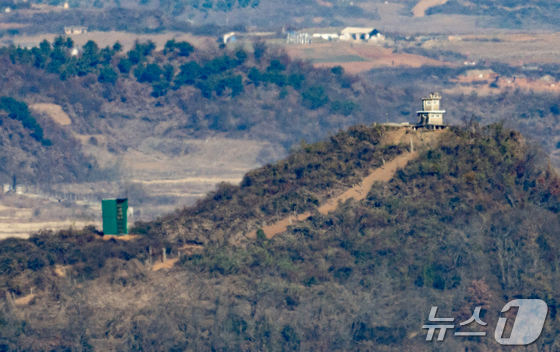
This year, North Korean forces have reportedly violated the Military Demarcation Line (MDL) a total of 16 times. Of these incidents, 13 occurred in October and November, sparking significant concerns within the government about potential accidental clashes between North and South Korea, as reported on Wednesday.
On November 17, the South Korean government proposed military talks with North Korea to delineate the MDL, likely in response to the increased frequency of North Korean incursions.
According to the Joint Chiefs of Staff (JCS), North Korean soldiers crossed the MDL on three consecutive days each week throughout November. U.S. and South Korean intelligence sources also detected signs that North Korea had been laying landmines south of the MDL. JCS data provided to Rep. Kang Dae-sik of the ruling People Power Party confirmed a total of 16 breaches so far, with 81 percent occurring in October and November.
The remaining three incidents occurred in April (2) and August (1). Specifically, on April 8 and 21, as well as August 19, North Korean troops crossed the MDL while constructing barriers along the border.
In October, there were three incursions on 18 (1) and 19 (2), coinciding with a North Korean defector incident, during which North Korean pursuit teams crossed the line.
November saw a total of 10 incursions, with North Korean forces crossing the MDL three days in a row each week, establishing a concerning pattern. From November 4 to 6, they crossed the MDL once a day near Yeoncheon in Gyeonggi Province, and from November 13 to 15, they repeated this pattern near Goseong in Gangwon Province. Even after Seoul officially proposed military talks with Pyongyang on 17, incursions continued on four more occasions. On November 19, North Korean forces crossed the MDL in Goseong, and from November 21 to 23, they breached near Goseong and Hwacheon once each day.
According to South Korean military sources, the number of individuals crossing the MDL is typically around 10, and most appear to be unarmed, aside from a few who seem to be in control. These individuals likely belong to units deployed for disruption measures, including the installation of anti-tank barriers and landmines, following North Korea’s declaration of the two-state principle.
Some operations reportedly occurred south of the MDL. However, neither U.S. nor South Korean forces have detected any incursions into clearly marked areas with MDL signs, leading them to assess the likelihood of intentional provocations as low.
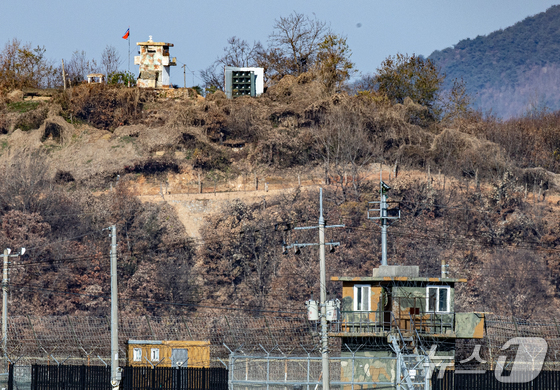
South Korean and U.S. troops respond to incursions by issuing warning broadcasts and may also fire warning shots if necessary. As incursions become more frequent, tensions naturally escalate along the border. Seoul’s proposal for military talks on November 17 can be viewed as a response to the recurring physical tensions rather than a genuine step toward dialogue.
South Korean President Lee Jae Myung, speaking to reporters en route to Turkey after attending the G20 summit in South Africa on Sunday, suggested that both North and South Korea struggle to recognize the MDL boundaries accurately. He noted that North Korean forces come and go, insisting it’s their land, while South Korean troops respond when they cross the line.
President Lee added that the repeated MDL violations and subsequent South Korean military responses are sharply raising tensions inside the Demilitarized Zone (DMZ), warning that this increases the risk of accidental clashes. He called for practical discussions between the two sides.
The trend of North Korean incursions has been increasing since last year, following their disruption measures. According to military authorities, North Korea recorded only 1 incursion in 2014 and 2 in. Still, by November 2023, following the breakdown of the September 19 Military Agreement and the declaration of the two states in December 2024, they had already recorded 9 incursions.
The MDL is marked by over 1,200 signs stating “Military Demarcation Line,” established shortly after the 1953 armistice agreement. Many of these signs have been lost over the years, leaving only about 200 remaining, which are often placed in rugged or wooded areas, limiting their effectiveness. South Korean forces regularly monitor incursions using coordinate identification equipment, but the North Korean military lacks similar resources.
This situation highlights the need to clarify the MDL boundaries to narrow the perceptual gap between North and South Korea through dialogue. However, North Korea has shown little response for over a week. South Korean military authorities are reportedly exploring additional measures, such as clearing search routes and establishing tactical roads, to address the ongoing incursions.
Representative Kang Dae Sik remarked that the continued incursions after the government’s proposal for military talks show a complete lack of willingness to engage in dialogue. He emphasized that North Korea’s repeated crossings of the MDL pose a dangerous risk of accidental clashes, urging South Korean and U.S. forces to maintain a heightened state of readiness.