

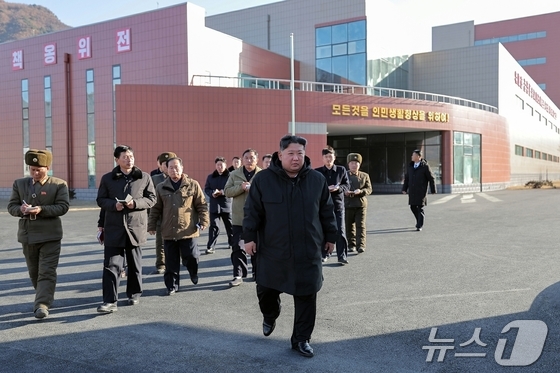
Kim Jong Un, the General Secretary of North Korea’s Workers’ Party, recently toured several local industrial plants in South Pyongan Province, including those in Sinyang, Pukchang, and Unsan counties. The visits were aimed at assessing the progress of this year’s local development strategy.
On Friday, the party’s official newspaper, Rodong Sinmun, reported that Kim had inspected various local industrial facilities nearing completion on Wednesday. He was accompanied by Jo Yong-won and Pak Jong-chon, secretaries of the party’s central committee.
During his visit to Sinyang County, Kim personally examined the military food factory, clothing factory, and daily necessities factory, evaluating their construction progress and operational readiness. He commended the construction team’s improved technical capabilities compared to the previous year, noting a reduction in process disparities and enhanced specialization.
Kim emphasized the importance of professionalism and precision in finishing work as crucial to construction quality. He expressed confidence that even with additional projects next year, such as health facilities and comprehensive service centers, the potential and experience of the people’s army would be sufficient to support these efforts.
Despite the local industrial revolution being less than two years old, Kim praised the completion of modern local factories in 40 cities and counties as a remarkable transformation. He underscored the importance of rural and local industrial development in improving living standards, stating that they are currently navigating through a critical historical transition.
However, Kim also pointed out operational biases in some factories and outlined tasks to boost production and enhance residents’ convenience.
During his inspection in Pukchang County, Kim sharply criticized discrepancies between the design and construction of the food factory. He noted that on-site changes deviated from initial plans, necessitating rework. Kim attributed this to the lack of a leadership system capable of promptly addressing such issues.
He called for the establishment of a tripartite agreement system involving design, construction, and operational units in factory construction. Kim also advocated for increased use of dry construction methods in industrial facilities and emphasized the need for greater modernization, standardization, and adherence to specifications.
Kim’s tour included a visit to a newly built paper factory in Unsan County. He described this facility as a pilot project to meet regional paper demand and lauded the technological advancements made by the State Academy of Sciences’ paper engineering research institute.
Looking ahead, Kim directed officials to develop specific plans for constructing modern paper factories across all provinces during the next five-year plan period. The goal is to meet the nation’s paper needs in science, education, and culture using domestically produced paper-making methods and technologies.
As the year draws to a close, Kim noted that this is the season when the year’s achievements are evaluated through completion and operational ceremonies. He urged all local industrial plants to be fully prepared for operations by the December ceremonies.
Kim’s Local Development 20X10 policy, introduced early last year, aims to establish 20 local industrial plants annually for a decade. With 20 plants already set up by the end of last year, a total of 40 are expected to be operational by this year’s end. Kim’s personal visits to construction sites appear to be part of his efforts to encourage and oversee the timely completion of these projects.