

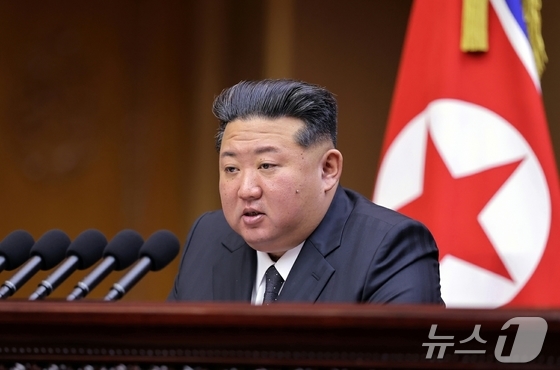
Experts predict that North Korea will enshrine Kim Jong Un’s revolutionary ideology in the party constitution at the upcoming 9th Workers’ Party Congress, scheduled for early next year. They also suggest that Kim may be given the title of “Supreme Commander of the Republic.”
Yang Mo Jin, a professor at the University of North Korean Studies, shared these insights on Tuesday during a forum titled “2026 Outlook on the Korean Peninsula and Policy Tasks,” hosted by the Institute for National Security Strategy at the Four Seasons Hotel in Seoul.
Professor Yang stated that North Korea will likely view the completion of its nuclear capabilities and the normalization of party-centered governance, as discussed during the 8th Party Congress (2021-2025), as evidence of Kim Jong Un’s leadership prowess. He anticipates that the upcoming 9th Party Congress will adopt an independent ideological doctrine distinct from that of previous leaders, officially marking the era of Kim Jong Un.
He further predicted that Kim Jong Un’s revolutionary ideology, centered around “Our State First” and “People First” principles, could be formally enshrined in the party constitution.
Additionally, Professor Yang speculated that if Kim might be granted the title of “Supreme Commander of the Republic, he could assume the role of “President” through a restructuring of state institutions.
The title of “Supreme Commander of the Republic” was previously reserved for Kim Il Sung, encompassing both the roles of supreme military commander and head of state. Kim Il Sung was appointed as an army marshal shortly after the Korean War in 1953 and later elevated to “Supreme Commander” in 1992. In contrast, Kim Jong Il was posthumously granted this title in 2012.
Although Kim Jong Un appeared to wear the rank insignia of Supreme Commander during the 90th anniversary parade of the Korean People’s Revolutionary Army in 2022, North Korea has not officially announced his ascension to this title.
Professor Yang predicts that North Korea will accelerate its efforts to deify Kim Jong Un in conjunction with the 9th Party Congress while also tightening social control. He believes that surveillance related to the so-called “three major control laws”—the Anti-Reactionary Thought and Culture Law, the Youth Education Guarantee Law, and the Pyongyang Cultural Language Protection Law—will intensify.
He further predicted that North Korea’s policy of hostility toward South Korea may become more institutionalized and explicit. Yang said that reversing the policies maintained over the past two years could create internal confusion or weaken Kim’s authority. He suggested that the 9th Party Congress could formalize constitutional amendments, which could then be enacted through the Supreme People’s Assembly.