


Reports indicate that Kevin Kim, the U.S. Chargé d’Affaires to South Korea, emphasized the need for a coordinated voice within the South Korean government on North Korea policy during a meeting with Unification Minister Chung Dong Young. Analysts on Tuesday interpreted this as a U.S. message urging Seoul to exercise caution in its conciliatory approach toward Pyongyang.
During his November 25 meeting with Minister Chung, Kim reportedly stressed the importance of securing negotiating leverage to bring North Korea to the dialogue table.
Kim was said to have insisted on maintaining existing sanctions to preserve that leverage and emphasized continued pressure on North Korea over human rights issues. He reportedly conveyed to Minister Chung that President Donald Trump desires to negotiate with North Korea from a position of overwhelming strength, highlighting these two points as prerequisites.
Notably, Chung had also attended a seminar earlier on November 25, where he said the Korean Peninsula issue could not be solved through bureaucratic thinking that waits for U.S. approval. Kim’s subsequent comments have been interpreted as a tacit warning from Washington.
Some observers believe Kim communicated U.S. discomfort with the so-called pro-autonomy faction within the Lee Jae Myung administration through Minister Chung. This analysis suggests the U.S. is siding with the alliance faction, which seeks to address North Korean issues within an international framework, rather than the pro-autonomy faction advocating for a bilateral approach to inter-Korean relations.
Although the government rejects terms such as pro-autonomy and alliance factions and denies any internal division, a clear split has emerged. Officials such as National Intelligence Service Director Lee Jong Seok and Minister Chung advocate stronger inter-Korean engagement, while National Security Office Director Kim Sung Han and Foreign Minister Park Jin focus on diplomacy centered on the U.S.-South Korea alliance.
In this context, Kim’s meeting with Minister Jeong, seen as a spokesperson for the pro-autonomy faction, and his discussion of aligning U.S.-South Korea approaches have been interpreted as a U.S. warning to the pro-autonomy faction not to overstep.
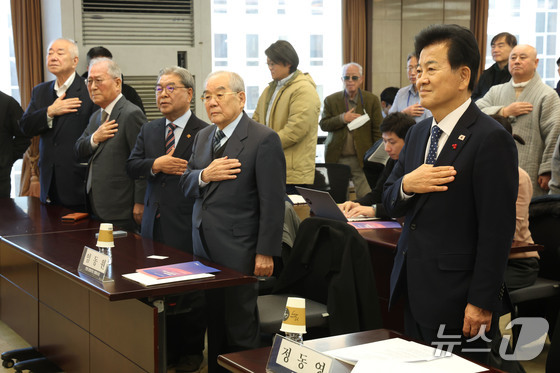

Courtesy of the Ministry of Unification
@@@
The Trump administration’s North Korea policy remains unclear. Although some interpreted Trump’s reference to nuclear power as a possible shift, the October agreement between the U.S. and South Korean presidents on denuclearization indicates that Washington is still shaping its strategy.
In this context, Kim’s emphasis on sanctions and human rights issues as pressure points for negotiations suggests the U.S. is now formulating a comprehensive North Korea strategy.
The South Korean government currently believes that U.S.-North Korea dialogue must precede inter-Korean talks. President Lee Jae Myung appears to be balancing pro-autonomy views in government-level measures toward North Korea with alliance-focused diplomatic responses.
Some fear that, following what is viewed as a U.S. warning, Washington may pressure Seoul to curb the influence of the pro-autonomy faction as the U.S. finalizes its North Korea strategy. Concerns stem from the possibility that the U.S. could selectively adopt South Korean positions only when they align with American interests.
Recent U.N. Command denials of DMZ access to key South Korean officials have raised concerns about potential U.S.-South Korea tensions reminiscent of the Moon Jae In era, suggesting a possible rift between the pro-autonomy faction and the United States.