

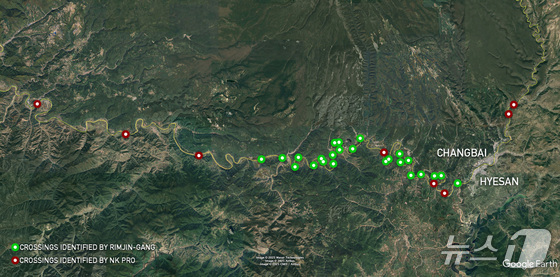
Satellite imagery analysis on Wednesday revealed that China has established at least 32 temporary crossing points along the Yalu River, operating an unofficial trade network to support North Korea. This indicates that both countries are extensively using alternative routes to circumvent the sanctions monitoring systems of the United Nations (UN) and other international bodies.
NK News, a U.S.-based media outlet specializing in North Korean affairs, reported that long-term analysis of satellite photos from Planet Labs showed these temporary crossing points are spread across a 59-mile (about 95 km) stretch in five areas of North Korea’s Yanggang Province: Kim Hyong Jik County, Kim Jong Suk County, Samsu County, Hyesan City, and Bochon County. This region, which suffered severe flood damage in 2024, borders Baishan City in China’s Jilin Province across the river.
Satellite images indicate that the number of these temporary crossing points increased gradually from 2024 to 2025. Four initially appeared between April and June last year, followed by seven more from October to December. In the first quarter of this year, five additional points emerged, with 14 more added by June.
The crossing method is straightforward: excavators create dirt paths in shallow areas, allowing trucks and vehicles to traverse. When river level changes wash away some crossing points, they are repeatedly destroyed and rebuilt, sometimes slightly relocating. Analysts also identified numerous new staging areas and parking lots for trucks and cargo on both riverbanks.
These crossing points operate independently from official trade routes such as the Yalu River Railway Bridge (North Korea-China Friendship Bridge) and customs facilities connected by bridges and railways in certain border areas. NK News suggests this method is linked to China’s strategy to evade sanctions.
While goods passing through customs are recorded, making it difficult for China, a permanent member of the UN Security Council, to avoid criticism for violating sanctions, the movement of goods through temporary crossing points leaves no record. This allows the Chinese government to potentially attribute such activities to arbitrary actions of local governments or regional businesses. NK News argues that given the large scale and frequency of goods movement observed via satellite, it’s highly improbable that Chinese authorities are unaware of these activities.
Notably, most crossing points are adjacent to the G331 Expressway (Changbai Mountain Circular Road), which China is constructing along a 1,400 km (about 870 miles) stretch near the border. The frequent movement of large construction equipment and trucks for this project across the Yalu River enables China to potentially disguise unofficial goods transfers to North Korea as construction-related activities.
NK News speculates that these temporary crossing points likely facilitate the transfer of civilian vehicles, expensive machinery, and equipment suitable for weapons manufacturing – items the Chinese government would be reluctant to export officially to North Korea.
Since last year, North Korea has been expanding its new weapons development facilities. Following Kim Jong Un’s September declaration to exponentially increase nuclear weapon production, the demand for related equipment has surged. NK News assesses that this covert crossing system could be a crucial component in supporting North Korea’s acquisition of military and industrial facilities.
Additionally, North Korea may be expanding unofficial trade to stimulate economic activities among local donju (emerging wealthy class) while maintaining social control and increasing fiscal revenue. North Korea began allowing private vehicle ownership last year, with a significant number of these vehicles reportedly entering the country through China.
NK News notes that while temporary crossing points have been used in the past to evade sanctions, the simultaneous establishment and operation of 32 crossing points is unprecedented. They interpret this as evidence that North Korea-China relations are solidifying in a direction that effectively circumvents the international sanctions regime.