

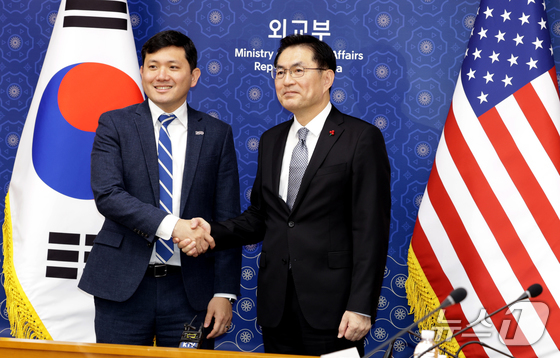
On Tuesday, the U.S. and South Korea initiated regular consultations to coordinate their overall North Korea policy and discuss the implementation of the joint fact sheet from their recent summit in Gyeongju.
The first meeting took place at the South Korean Ministry of Foreign Affairs in Seoul, with Jeong Yeon-du, head of the Ministry’s Strategic Information Division, and Kevin Kim, the U.S. Deputy Ambassador to South Korea, leading their respective delegations.
Officials from both countries’ Foreign and Defense Ministries attended the meeting. The U.S. delegation included representatives from the State Department and the Department of Defense, such as Scott Johnson, the Pentagon’s regional director for Korea, and Anthony Henderson, who oversees strategic planning and policy at U.S. Forces Korea.
The South Korean Ministry of Unification was notably absent from the meeting, having announced the previous day that it would pursue separate channels for discussing North Korea policy with the U.S.
This consultation aims to formalize existing communication channels between diplomatic authorities to coordinate North Korea policy. The Foreign Ministry emphasized that this does not signify the creation of a new consultative body like the 2018 Korea-U.S. Working Group.
The Foreign Ministry initially called this meeting the Regular Consultations on North Korea Policy, but later changed it to Follow-up Consultations on the Joint Fact Sheet from the Korea-U.S. Summit. This change appears to address concerns raised by the Ministry of Unification about the Foreign Ministry’s leadership role in North Korea policy.
A Foreign Ministry official explained that the name change reflects the importance of the joint fact sheet and its implementation as a key bilateral task.
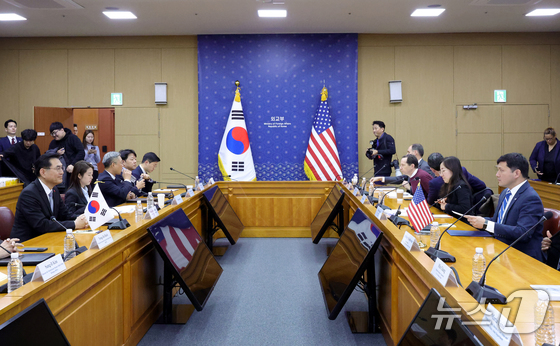
The meeting lasted longer than expected, running for about 3 hours and 30 minutes. The two sides likely exchanged broad views on the key points of the joint fact sheet. While the Foreign Ministry stated that various Korean Peninsula issues were comprehensively discussed, specific details were not disclosed.
The fact sheet previously released by both countries included commitments to North Korea’s complete denuclearization, peace and stability on the Korean Peninsula, implementation of the 2018 Singapore Joint Statement, close coordination on North Korea policy, and calls for North Korea to return to dialogue and comply with international obligations regarding weapon of mass destructions (WMDs) and ballistic missile programs.
The document also addressed defense budget increases and South Korea’s plans to acquire nuclear-powered submarines, suggesting that related schedules and plans were likely discussed during the meeting.
The Foreign Ministry stated that both countries agreed on the importance of close coordination in advancing their Korean Peninsula policies and decided to enhance communication at all levels going forward.
Deputy Ambassador Kim encountered reporters when entering and leaving the Foreign Ministry building but did not respond to any questions.
The two countries likely focused on maximizing synergy in light of South Korea’s announcement to launch a Korean Peninsula Peace Coexistence Process involving inter-Korean dialogue starting next year.
The U.S. reportedly views current sanctions against North Korea and pressure on human rights issues as potential leverage for future negotiations. As such, they likely discussed how to align this approach with South Korea’s more conciliatory stance toward North Korea.
Additionally, the U.S. may have expressed concerns about recent conflicts between South Korea’s Foreign Ministry and Ministry of Unification, and the potential impact on North Korea policy due to internal divisions between independent and alliance factions within the South Korean government.