

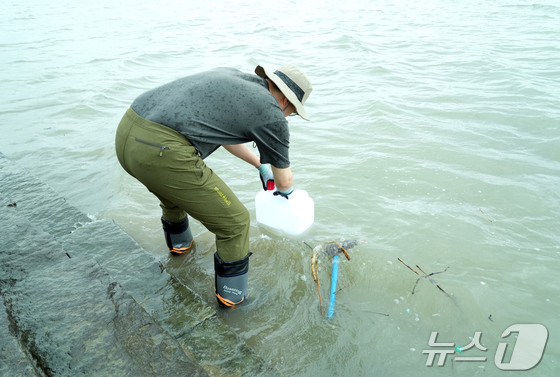
The government announced on Wednesday that the regular uranium concentration monitoring conducted in December showed no abnormalities. This monitoring was prompted by concerns over potential radioactive discharge into the West Sea from North Korea’s Pyongsan uranium plant.
Earlier this month, officials collected samples from seven key locations and analyzed them for uranium and five heavy metals.
Uranium concentrations were found to be within normal ranges: 1.825 to 2.570 ppb at three sites in the Ganghwa area, 0.339 to 0.394 ppb at two sites along the Han and Imjin Rivers, and 3.178 to 3.221 ppb at two sites along the Incheon coast.
While the Ganghwa site showed a slight increase of about 1 ppb compared to last month, the Nuclear Safety Commission explained that this variation falls within the natural fluctuation range due to seawater influence.
The monitoring also confirmed no abnormalities in the detection of five heavy metals—cadmium, arsenic, mercury, lead, and hexavalent chromium—across all seven sites. These levels were either below environmental standards or undetectable.
Based on the consistent results over the past six months, the government plans to transition from monthly to quarterly monitoring starting next year. The next set of monitoring results is scheduled for release in March 2024.
The government stated that it will continue quarterly monitoring to safeguard public safety.