

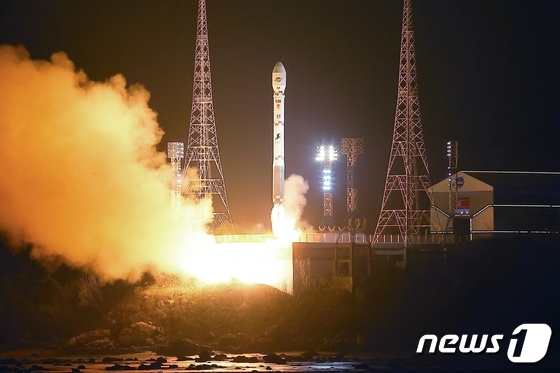
North Korea has demonstrated a keen interest in global space development efforts, closely monitoring international laws and treaties related to the field. On Wednesday, analysts speculated that Pyongyang might resume its military reconnaissance satellite program in the coming year, following a hiatus in 2023.
The state-run Rodong Sinmun reported on the, Intensifying Space Development Initiatives, highlighting the growing international focus on space exploration and the competitive rush by nations worldwide to achieve breakthroughs in this domain.
The newspaper spotlighted the International Lunar Research Station (ILRS) project, a joint venture between Russia and China. It described the ILRS as a cutting-edge lunar facility equipped for exploration, observation, and scientific experiments, detailing the project’s inception through a 2021 bilateral agreement.
The article also noted the recent BRICS space agency summit, where Roscosmos, Russia’s space agency, announced the participation of 13 additional countries in the ILRS project, including Azerbaijan, Belarus, Bolivia, Venezuela, and Egypt.
By closely examining these collaborative space initiatives involving its allies, North Korea appears to be signaling its own aspirations in space development.
In a separate section on World Knowledge, the newspaper outlined key principles of international space law. It emphasized that outer space, including the Moon and other celestial bodies, must be freely accessible to all nations on an equal basis, without discrimination or monopolization by any single state. The article also highlighted the ban on deploying nuclear weapons or other weapons of mass destruction in Earth’s orbit or outer space.
Following two failed attempts in 2023, North Korea successfully launched its military reconnaissance satellite, Malligyong-1. Despite General Secretary Kim Jong Un’s public commitment to launch three additional satellites in 2024, this plan has yet to materialize.
Ongoing speculation suggests that North Korea may acquire advanced reconnaissance satellite and launch technologies from Russia in exchange for military support. If such assistance materializes, experts anticipate that the regime may announce the resumption of its military satellite program at the upcoming 9th Workers’ Party Congress, scheduled for early next year.