

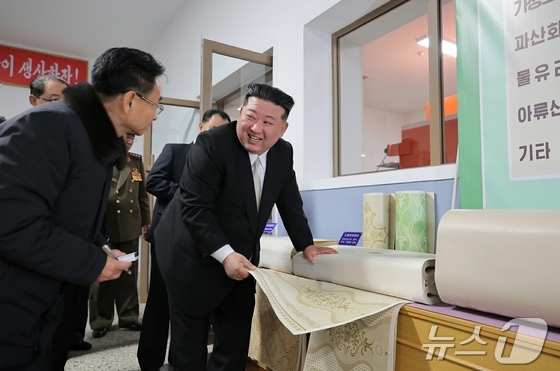
Kim Jong Un, the General Secretary of North Korea’s Workers’ Party, attended the inauguration ceremony of a paper factory in Unsan County, South Pyongan Province. He announced plans to construct more paper factories nationwide. While Kim’s focus on improving citizens’ lives is evident, analysts suggest his specific emphasis on paper production is a calculated move to showcase his attention to detail, as reported on Tuesday.
North Korea continues to grapple with securing high-quality paper, with most schools and businesses still relying on low-grade yellow paper. Kim’s direct involvement in addressing this issue is viewed as a strategic move – a low-cost, high-impact approach aimed at garnering public support with minimal resources.
On December 28, Kim personally attended the Eunsan paper factory inauguration. That day, he juggled two engagements: the factory visit and an inspection of a new cruise missile launch site. Notably, the Workers’ Party’s official newspaper, Rodong Sinmun, prioritized Kim’s factory visit as the front-page headline in its report on Monday. This editorial choice underscores the regime’s current focus on internal cohesion rather than external affairs.
Kim lauded the completion of the new factory, highlighting its advanced paper-making technology capable of utilizing various local materials and tree species. He emphasized the factory’s significant economic benefits and noted that it serves as a model for other provinces to emulate in constructing their own paper facilities. The term model experience implies that other regions should benchmark Eunsan County’s paper factory for future local paper production initiatives.
On December 3, Kim inspected the Eunsan paper factory construction site. He directed all provinces to engage in detailed discussions and planning for modern paper factory construction during the upcoming five-year plan period, set to be announced at the 9th Party Congress.
During the Year-End Plenary Meeting held from December 9 to 11, Kim again referenced the Eunsan paper factory. He instructed each province, city, and county to generate results aligned with their unique characteristics. This consistent narrative portrays paper production as Kim’s primary concern, a calculated move by the regime.
Kim Strategically Addressing Basic Infrastructure Issues to Win Public Support
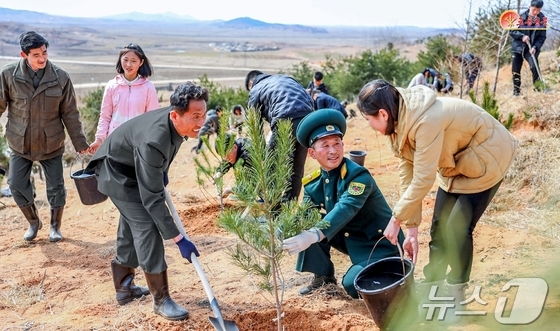
North Korea’s paper production remains severely underdeveloped, largely due to widespread fuel shortages that force the use of most wood for heating and cooking rather than paper production.
The United Nations Development Programme (UNDP) reports a stark decline in North Korea’s forest coverage. In 1990, forests covered approximately 68% of the country’s land area. By the 2010s, this had plummeted to around 40%, indicating a long-term, severe deforestation crisis.
As a result, North Korean paper production heavily relies on recycled materials or alternative non-wood sources. This leads to poor-quality paper that tears easily and is unsuitable for many applications.
North Korean state media consistently report on these paper production challenges and tout various party and state-level efforts to overcome them.
In September 2019, the Chosun Sinbo, a newspaper affiliated with pro-North Korean residents in Japan, published an article titled, A Breakthrough in Paper Production is Firmly Opening Up. It reported that the Sinuiju Chemical Fiber Factory was developing a paper production process using 100% reed fiber, eliminating the need for wood pulp.
In July of this year, North Korea’s state propaganda outlet Nara claimed that the State Academy of Sciences’ Paper Engineering Research Institute had developed paper manufacturing technology using fallen leaves. While these media outlets present the use of fallen leaves and reeds as innovative technology, the reality is quite different, reflecting the dire state of the country’s paper industry.
Professor Im Eum-chul from Kyungnam University’s Institute of East Asian Studies offers insight: In North Korea, paper production issues are severe, with most institutions still relying on what we call waste paper. Kim’s personal involvement in the paper factory project, while emphasizing infrastructure development under the banner of people-first politics, appears to be a calculated effort to demonstrate active problem-solving and garner public support.