

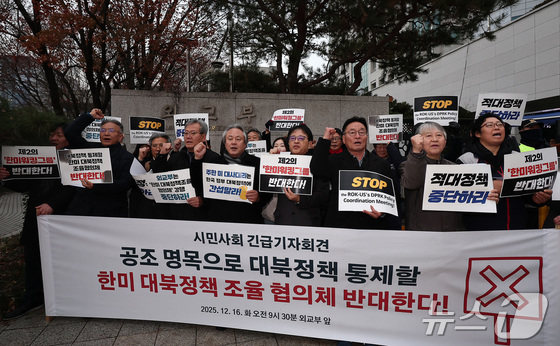
On Wednesday, 143 scholars specializing in inter-Korean relations issued a statement reiterating their opposition to the U.S.-South Korea North Korea Policy Consultative Body, asserting that it is neither urgent nor necessary at this juncture.
In their statement, titled, Scholarly Statement on the Problematic Launch of the U.S.-South Korea North Korea Policy Consultative Body, the academics highlighted that this consultative body, which convened its inaugural meeting on December 16, evokes memories of the 2018 U.S.-South Korea Working Group. That group, they argue, thwarted all new initiatives in inter-Korean relations.
The statement was endorsed by prominent figures including Lee Hae-young, Chairman of the Multilateral Forum and professor at Hanshin University; Kim Jin-hyang, Chair of the Korea Peace Economic Conference; Moon Jang-ryeol, former professor at the National Defense University; Lee Hye-jung, professor at Chung-Ang University; Kim Dong-yeop, professor at the Graduate School of North Korean Studies; Nam Ki-jung, professor at Seoul National University; and Lee Jang-hee, emeritus professor at Hankuk University of Foreign Studies.
The scholars contended that the working group, established at the behest of the U.S. and agreed to by South Korea, has subordinated South Korean interests to U.S. strategic objectives for nearly three years. Inter-Korean relations have virtually collapsed, compromising the security interests. They further emphasized that despite the name change, this consultative body’s core purpose remains identical to that of the working group.
The academics specifically criticized the makeup of the U.S. delegation to the consultative body. This includes the Deputy Chief of Mission at the U.S. Embassy in Korea, the Acting Deputy Assistant Secretary of State for East Asian and Pacific Affairs, senior analysts from the State Department’s Bureau of Intelligence and Research (INR), the State Department’s North Korea Policy Coordinator, the Department of Defense’s Korea Desk Officer, and legal advisors on North Korea sanctions. They argue that this composition reveals an intent to effectively control and oversee South Korea’s North Korea policy across diplomatic, military, intelligence, and legal domains.
The scholars unanimously declared that it’s unrealistic to expect North Korea to engage in dialogue that’s clearly controlled by external forces.
Previously, on December 9, when the Ministry of Foreign Affairs announced plans for a U.S.-South Korea meeting to discuss comprehensive North Korea policy, Unification Minister Chung Dong-young asserted that inter-Korean relations fall under national sovereignty. He stated that the Ministry of Unification should be the primary entity for consultations with the U.S. ally on this matter, indicating his intention to abstain from the meeting.
Subsequently, as opposition to the consultative body mounted from academic and civil society sectors, the Ministry of Foreign Affairs altered the meeting’s designation from Regular Consultations on North Korea Policy (Coordination Meeting) to Follow-up Consultations on the Joint Fact Sheet from the U.S.-South Korea Summit. The first meeting under this new title was held on December 16.