

On Tuesday, the People Power Party criticized President Lee Jae Myung’s Korea-China summit, stating that it concluded as a mere ceremonial event without securing any substantial diplomatic or security benefits for South Korea.
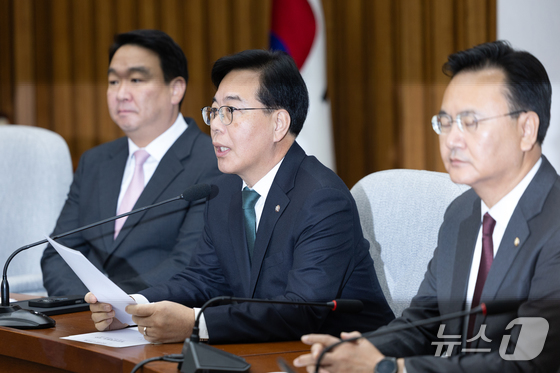
During a party leadership meeting at the National Assembly that morning, floor leader Song Eon Seok said that when North Korean leader Kim Jong Un visited China last September, Foreign Minister Wang Yi, who holds a much higher political rank than the official who welcomed our president, personally greeted him. This clearly demonstrated who China strategically values.
He continued, “There was no apology for the illegally installed Chinese structures in the West Sea, and we only received vague statements about ‘public seas’ without any promise of removal. Regarding the North Korean nuclear issue, while President Lee mentioned peace on the Korean Peninsula, President Xi Jinping sidestepped the topic by referring to regional peace.”
Song also criticized what he described as China’s attempt to weaken South Korea’s core security pillars by urging Seoul to make the right strategic choices, a remark he said clearly pointed to the Korea–U.S. alliance and Korea–U.S.–Japan cooperation.
He emphasized that the numerous memorandums of understanding promoted by the government were merely non-binding declarative agreements. In his view, the summit should ultimately be assessed as one in which South Korea returned with a warning from China to choose sides wisely, rather than with concrete measures to protect its core national interests.
Secretary-General Jeong Hee Yong expressed concern, saying a comprehensive review of the summit briefings revealed inconsistencies in how the outcomes were explained and interpreted. While summits are meant to build mutual trust, he said, they must also clearly safeguard national interests at the center of diplomacy.
Jeong added that the meeting should be evaluated not by its friendly atmosphere but by how accurately national interests were reflected and managed. He stressed that the government needs to communicate more responsibly about the scope, nature, and content of the agreements reached to avoid unnecessary disputes stemming from differing interpretations.
Opposition lawmaker Kim Geon, the minority spokesperson for the National Assembly’s Foreign Affairs and Unification Committee, criticized the government for raising expectations for the summit as a state visit to China after nine years. He said that although there were no major missteps, the summit yielded no tangible results, likening it to a beautiful but hollow fruit.
Kim also pointed out that President Lee had declared in his opening remarks that 2026 would mark a full restoration of Korea–China relations, yet no official joint statement was issued to support that claim. He noted the absence of any document addressing key public concerns, including lifting China’s restrictions on Korean cultural content, North Korean denuclearization, and the West Sea structures.
He emphasized that since the establishment of diplomatic relations between Korea and China in 1992, joint statements have been issued in every state visit to China except for two instances involving extraordinary circumstances, such as the first North Korean nuclear crisis in 1994 and China’s retaliation over THAAD deployment in 2017. These statements clearly outline the specifics of cooperation between the two countries.
He concluded that if no joint statement had been prepared at the working level from the outset, it raised questions about whether a state visit to China at the beginning of the year had been necessary at all.