

On the day of the summit between President Lee Jae Myung and Chinese President Xi Jinping, North Korea showcased its close alignment with Russia. This move sent a tacit message that its diplomatic ties with Russia are more important than the South Korea-China meeting.
In contrast to the previous day’s launch of a new ballistic missile (hypersonic) into the East Sea, North Korea appeared to adopt a stance of indifference. Analysts on Tuesday suggested that North Korea is likely to continue its “my way” approach, prioritizing its own interests over involvement in other issues until the 9th Workers’ Party Congress, slated for January or February.
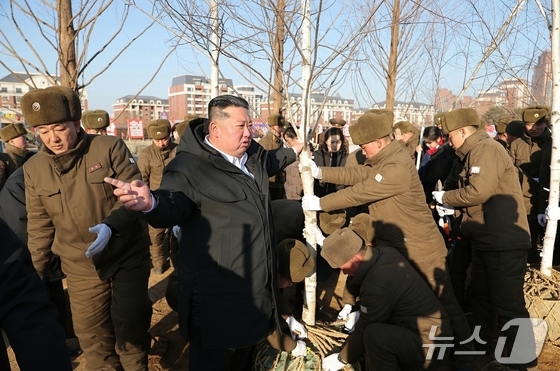
The Workers’ Party’s official newspaper, Rodong Sinmun, reported that on Monday, Kim Jong Un, accompanied by his daughter Ju-ae and high-ranking party and government officials, visited the construction site of a memorial for overseas military operations. This site, which broke ground last October, is designed to showcase the achievements of troops deployed to Russia and honor fallen soldiers.
On that day, North Korean state media, including Rodong Sinmun, neither reported on the South Korea-China summit nor offered any commentary on its outcomes. This stands in stark contrast to the provocative hypersonic missile launch that seemed to challenge South Korea during President Lee’s first day in China on Sunday.
Instead, through Kim’s focus on Russia, North Korea emphasized that its most crucial diplomatic partner at present is Russia. Simultaneously, this approach appears aimed at boosting public morale by honoring fallen soldiers ahead of the 9th Workers’ Party Congress.
Current interpretations of North Korea-China relations are mixed. Some observers note that neither side has significantly improved ties. In contrast, others argue that, following Kim’s attendance at China’s 80th-anniversary celebration of victory over Japan last September and the subsequent North Korea-China summit, China has once again become North Korea’s ally.
However, given China’s current focus on its power struggle with the U.S., related tensions with Japan, and the ousting of Venezuela’s government (a former close ally), the prevailing view is that the current North Korea-China relationship is not a major factor in Northeast Asian diplomacy. This suggests that North Korea will likely focus on issues that offer tangible benefits.
Seo Bo Hyeok, a senior researcher at the Korea Institute for National Unification and chair of the North Korea Studies Association, noted that amid the conflictual international order, it’s a rational policy decision for North Korea to prioritize domestic economic development and regime consolidation over active foreign diplomacy.
The Blue House announced that during the South Korea-China summit, President Lee and President Xi agreed on the importance of dialogue with North Korea. They also committed to exploring creative measures to ease tensions and build peace on the Korean Peninsula.
However, neither President Xi nor Chinese state media made any comments about North Korea, denuclearization, or the Korean Peninsula, maintaining strategic silence. From North Korea’s perspective, this could reinforce the belief that China still values its relationship with North Korea more than with South Korea.
Consequently, North Korea has navigated one of its most crucial diplomatic events of the year, the South Korea-China summit, without incurring any losses. This allows it to minimize external variables as it considers new foreign policy directions at the upcoming 9th Party Congress.
Experts believe that North Korea is unlikely to adopt a proactive foreign policy at the 9th Party Congress.
Last December, Kim expressed hostility when inspecting the construction site of a nuclear-powered strategic guided missile submarine, stating that South Korea’s planned nuclear submarine, confirmed by the U.S.-South Korea agreement, must be addressed. He has continued to showcase nuclear strategic weapons and conventional arms aimed at the U.S. and South Korea, indicating little interest in dialogue.
Additionally, as the U.S. moves to oust Venezuela’s dictator Nicolás Maduro, Kim’s position, which could parallel Maduro’s, complicates his ability to trust President Donald Trump.
China’s lack of active involvement in North Korean issues and the difficulty in building trust between the U.S. and North Korea may hinder the South Korean government’s efforts to create an April turning point during President Trump’s visit to China.
The government envisions an ideal scenario where, if President Trump proposes dialogue, North Korea would engage under China’s protection or persuasion, with South Korea mediating. However, at this stage, finding a decisive factor to entice both China and North Korea seems challenging.