

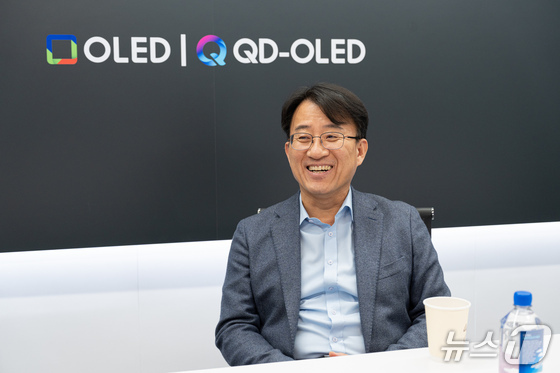
China is making significant strides in the 8.6-generation information technology (IT) organic light-emitting diode (OLED) market, but there’s still a substantial technology gap between Samsung Display and Chinese companies. With Samsung Display’s mass production of 8.6-generation IT OLEDs this year, it anticipates a 20-30% growth in IT business revenue compared to last year. Samsung Display Chief Executive Officer (CEO) Lee Chung shared these insights on the company’s plans and outlook for the display market. He also emphasized their goal to expand market share in the automotive OLED sector.
On January 7, Lee met with reporters at the Consumer Electronics Show (CES) 2026 in Las Vegas to discuss Samsung Display’s CES activities and strategic plans for the year.
Samsung Display has ramped up investment in 8.6-generation IT OLEDs, with mass production set to begin this year. This next-gen technology uses larger glass substrates than existing products, maximizing panel production efficiency. Lee stressed that the priority now is to successfully launch the 8.6-generation OLED. A successful rollout will naturally lead to further investment expansion.
Regarding Chinese firms’ 8.6-generation OLED capabilities, Lee noted that they’re working hard, but there’s still a significant technology gap between Samsung Display and Chinese companies. He added that while mature technologies may be comparable, they’re continuously developing new innovations to maintain and widen the lead.
Lee projected that with successful mass production of 8.6-generation IT OLEDs, Samsung Display’s IT business would see growth. He stated that they’re just starting this year, but he expects a 20-30% increase in revenue and unit sales compared to last year.
Samsung Display is also pushing into the automotive digital cockpit market. At CES, they unveiled a new digital cockpit demo featuring the Flexible L Center Information Display (CID), which integrates seamlessly with the front dashboard. Lee mentioned ongoing collaboration with Hyundai Motor Company, adding that the rise of electric vehicles has increased OLED awareness in the auto industry. While still pricier than liquid-crystal displays (LCDs), they’re introducing OLEDs in high-end models and aim to gradually increase the automotive OLED market share.
Samsung Display showcased a crease-free foldable OLED panel, reducing crease depth by about 20% compared to existing products. Lee emphasized that for foldable panels, the key factors are thinness, durability, and crease elimination. It is confident in ongoing improvements. He expressed high expectations for foldables this year.
This CES also featured significant advancements in smart glasses. Lee noted that Samsung Display is collaborating closely with various companies on commercialization technologies in this area.
South Korea currently ranks second in global display market share, behind China, aiming to reclaim the top spot by 2027. As president of the Korea Display Industry Association, Lee said that while it hopes to regain the number one position, it’s challenging since Korea no longer produces LCDs for the large television (TV) market. Reclaiming overall market leadership will require substantial effort. He acknowledged the TV sector’s difficulties, emphasizing the need for innovative technologies to stimulate new demand.
This Year’s CES Showcased a More Diverse and User-Friendly Range of AI Concepts
Lee observed that while artificial intelligence (AI) themes are similar to last year, the implementations are more varied, deeper, and user-friendly, offering more comprehensive solutions.
At CES 2026, Samsung Display exhibited various OLED products, focusing on AI-OLED integration. Lee explained that the exhibition targeted customers across diverse sectors like automotive and IT, necessitating a wide product range. He noted high attendance from customers and suppliers, particularly from the automotive industry, and mentioned discussions with major U.S. AI tech firms about potential collaborations.
Physical AI emerged as the central theme at CES, with humanoid robots garnering significant attention. Lee clarified that while Samsung Display isn’t in robotics, they’re focused on providing displays for robots. The goal is to be the go-to supplier for all robot displays.
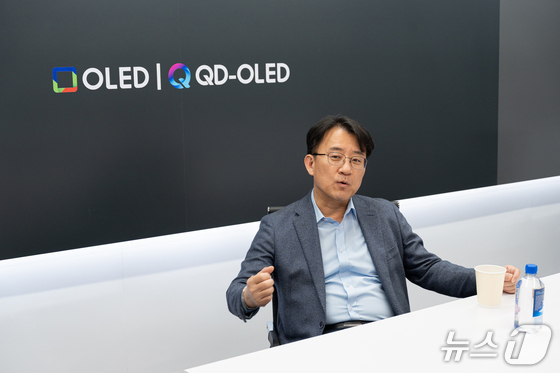
Memory Semiconductor Pricing, Main Risk for This Year’s Display Market
Lee explained that while the memory semiconductor market benefits Samsung Electronics, set manufacturers face challenges from rising prices and supply constraints.
He added that if set manufacturers reduce sales due to these risks, it inevitably impacts component suppliers like them. It’s understandable that they seek to cut costs elsewhere when faced with price increases in one area.