Claims have emerged in the U.S. Congress that the South Korean government is unfairly discriminating against American tech companies.
Notably, Coupang, which focuses on e-commerce in South Korea, has been singled out as an American tech company allegedly receiving unfair treatment from the Korean government.
During a trade subcommittee hearing on maintaining American innovation and technology leadership held at the Capitol in Washington, D.C., on Tuesday, U.S. House Ways and Means Committee Chairman Adrian Smith (R-Nebraska) stated that in his assessment, South Korea continues to pursue legislative efforts that explicitly target American companies.
Smith referenced a joint fact sheet released last November, saying that in this declaration, South Korea pledged to eliminate discrimination against American companies and remove unnecessary digital trade barriers. He expressed disappointment that, contrary to this promise, legislative initiatives from the South Korean government persist.
He added that it appears that South Korean regulatory authorities are actively targeting American tech companies, citing what he called discriminatory regulatory measures against Coupang as an example.
While there are no regulatory measures explicitly targeting Coupang alone, Smith’s mention of discriminatory regulatory measures likely refers to the South Korean government’s response to a recent massive data breach.
Representative Carol Miller (R-West Virginia) asserted that efforts to impede the free flow of digital trade are most pronounced in South Korea.
Miller criticized the South Korean National Assembly for continuing to push legislation targeting American companies, labeling the recently passed amendments to the Telecommunications Business Act as a censorship law.
She also pointed out that recently, there has been what she termed a political witch hunt against two American corporate executives, alleging that South Korea’s recent actions aim to drive American companies out of its market. This likely refers to Harold Rogers, Coupang’s interim representative in Korea, and Kim Bom-suk, chairman of Coupang Inc.
Coupang Inc., a U.S. corporation, fully owns Coupang’s South Korean subsidiary. Founded in Delaware in 2010 by American national Kim Bom-suk, it went public on the New York Stock Exchange in March 2021. The company is headquartered in Washington State, where Kim Bom-suk holds 70% of the voting rights, effectively managing the company.
Representative Suzan DelBene (D-Washington) also mentioned the trade agreement with South Korea, saying that she’s hearing from companies like Coupang in my district that South Korean regulators are already violating their commitments.
DelBene pointed out that while President Donald Trump spoke extensively about digital trade, the so-called agreement he negotiated lacks substantial enforcement mechanisms.
In this context, Nigel Cory, a director at U.S. consulting firm Crowell Global Advisors, who testified at the hearing, stated that South Korea represents a unique case as it seeks to adopt competition policies similar to those seen in Europe, following problematic policies while implementing its Digital Market Act.
Cory noted that American companies have a long history of being targeted by South Korean competition authorities. He mentioned that he conducted a survey of American companies last year and submitted a detailed analysis report to the National Asia Research Institute. He said that these companies belong to different sectors and have varied experiences, but they all expressed common grievances about the ongoing targeted actions by South Korean competition authorities.
Cory further emphasized that this is clearly a serious issue that goes beyond trade. He believes it is crucial for the administration to address these problems and solidify relevant provisions while continuing negotiations with South Korea.
He stressed the importance of creating specific and enforceable measures to ensure that American companies receive fair treatment, recalling that the most critical concerns expressed by companies during his report preparation were due process, procedural safeguards, and guarantees of procedural fairness.
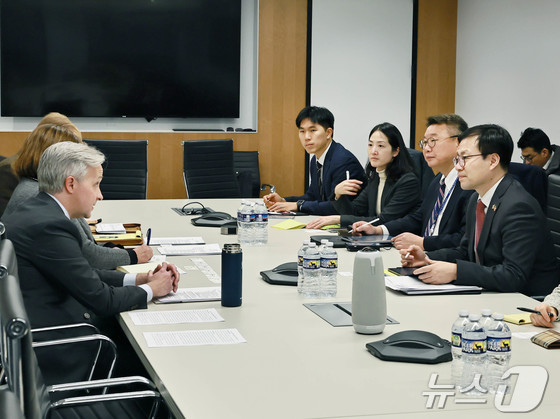
This hearing occurred as South Korea’s Yeo Han-koo, head of the Ministry of Trade, Industry and Energy’s Trade Negotiation Headquarters, visited the U.S. to address American concerns regarding South Korea’s digital legislative initiatives.
Cory mentioned that he understands that the head of South Korea’s Trade Negotiation Headquarters is in the U.S. this week to address this issue. However, fundamentally, American companies have continuously faced aggressive targeting from South Korean competition authorities, and the South Korean system lacks due process and procedural safeguards to ensure fair treatment.
On January 11, Yeo spoke with reporters at Dulles International Airport near Washington, D.C., stating that it seems necessary to clearly explain the legislative policy intentions, adding that there are misunderstandings on the American side.
He noted that he plans to meet with Katherine Tai, the U.S. Trade Representative (USTR), key members of Congress who frequently voice concerns about South Korea’s digital legislation, and representatives from various industry associations.
Yeo emphasized that regarding the Coupang data breach that fundamentally, it views the massive data breach at Coupang and the inadequate response afterward as the essence and core of the issue, asserting that it is essential to separate these matters from trade or diplomatic issues and handle them thoroughly.