

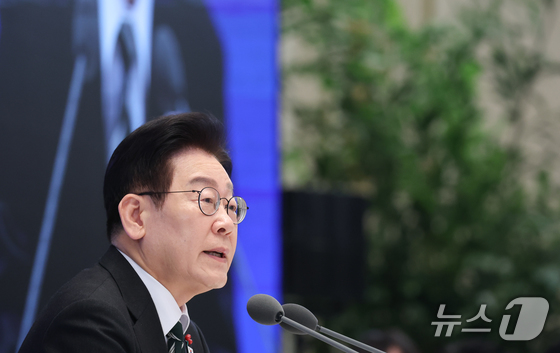
President Lee Jae Myung stated on Wednesday that he is not deeply concerned about the semiconductor tariff proclamation from the Trump administration.
During a New Year’s press conference held at the Blue House guest house that morning, he emphasized that they could respond by adhering firmly to their established principles and guidelines.
He added that this was a typical statement and that unexpected elements often emerged during intense confrontations, warning that overreacting to such situations could cause them to lose their focus.
Lee also speculated that imposing tariffs on Korean semiconductor companies could raise U.S. prices.
The President noted that Korea and Taiwan accounted for roughly 80–90% of the global semiconductor market and predicted that if tariffs were raised to 100%, semiconductor prices in the United States could rise accordingly
He said that while Korea might shoulder part of the burden, it was highly likely that most of the cost would ultimately be passed on to U.S. consumers. He added that although there was also a competitive dynamic with Taiwan, the specifics of the situation differed.
President Lee explained that the circumstances were somewhat different and that Korea had reached an agreement with the United States to ensure it would not be disadvantaged compared to Taiwan in such scenarios.
He added, however, that this could also imply being treated less favorably than Taiwan, noting that while he hoped Taiwan could weather the situation, such matters did not always unfold according to the wishes of any single country.
Lee remarked that he had heard suggestions that tariffs could be raised to 100% if semiconductor factories were not built in the United States, stressing that such comments were among the various discussions that can emerge during negotiations.
He added that the United States clearly wanted to attract more semiconductor manufacturing within its borders.
Concluding his remarks, Lee acknowledged the challenging headwinds facing Korea but said the situation did not pose a risk that could sink or seriously damage the country, expressing confidence that it could be navigated successfully.
Meanwhile, the Trump administration’s semiconductor proclamation is based on Section 232 of the Trade Expansion Act, which imposes a limited 25% tariff on advanced computing chips. The U.S. has indicated plans to expand the scope, potentially affecting memory semiconductor companies like Samsung Electronics and SK Hynix.
U.S. Secretary of Commerce Gina Raimondo stated on Friday that companies seeking to produce memory semiconductors effectively had two options: either pay a 100% tariff or manufacture in the United States. Although she did not name any specific country or company, analysts said the remarks appeared aimed at pressuring Samsung Electronics and SK Hynix, as Korean firms currently dominate the global memory semiconductor market.