

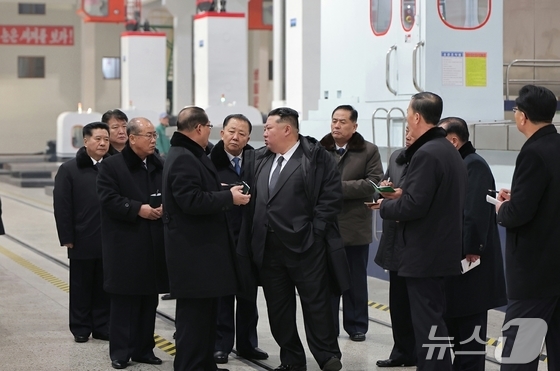
On Tuesday, analysts proposed that North Korean leader Kim Jong Un’s approach to on-site guidance is shifting from emphasizing public-friendly encouragement to reinforcing on-the-spot judgments targeting officials.
Park Eun-joo, a research fellow at the Korea Institute for National Unification, analyzed in her report, Changes in Kim Jong Un’s On-Site Guidance Patterns and Their Policy Implications, that Kim’s recent on-site guidance has rapidly evolved. It has moved away from the traditional framework of public-oriented encouragement to reaffirming the hierarchy of governing power and immediately penalizing policy failures on the spot.
In 2024, Kim dismissed an official following an emergency political bureau meeting during a flood recovery site visit. Last year, he classified a corruption case involving officials in Nampho City and Jagang Province as a major crime. Additionally, he immediately fired Deputy Prime Minister Yang Seung-ho at the Ryongsong Machine Complex’s completion ceremony this month.
Park noted that while past reprimands were carried out through administrative measures by party organizations or judicial institutions, the Supreme Leader now exercises personnel authority on-site. This transforms on-site guidance from a mere encouragement platform into a venue for immediate judgment. It indicates that the leader is elevating his status to that of a judge who makes judicial and personnel decisions directly during inspections.
This approach starkly contrasts with Kim’s initial image of being people-friendly. In a time of systemic crisis, the leader has stepped out from behind the scenes to directly exercise punitive power, which could be interpreted as a return to rule by fear.
Park also highlighted that during on-site guidance, Kim specifically and professionally points out inefficiencies in equipment specifications, process stages, and material supply. She explained that this refines the logic that the leader’s strategic judgment is sound, while the incompetence and negligence of bureaucrats hinder results. This creates a psychological mechanism that makes local officials accept harsh penalties as just punishment, instilling the perception that the leader is well-versed in practical matters.
Such displays serve to strengthen control by internalizing a sense of crisis within North Korea’s bureaucracy, where officials feel they could become subjects of judgment at any time. As the 9th Party Congress approaches, requiring an assessment of the past five years’ achievements amid chronic sanctions and resource shortages, there’s an apparent intent to blame the lack of visible results from the Local Development 20X10 Policy on bureaucratic negligence rather than policy flaws.
Park predicts that this fear-based politics may lead to administrative paralysis due to passive resistance within the bureaucracy, increased information distortion, reduction of the bureaucratic system to political expendables rather than policy drivers, and weakening of systemic cohesion.