

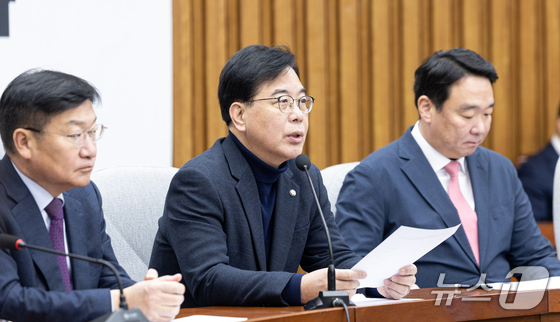
On Tuesday, the People Power Party criticized President Lee Jae Myung and the ruling party, asserting that they are responsible for President Donald Trump’s abrupt tariff hikes. The party argued that Trump’s recent action, coming just a day after Prime Minister Kim Min Seok’s return from the U.S., could be linked to a potential decline in U.S.-South Korea trust following the arrest of Pastor Son Hyun Bo and the investigation into Coupang.
During a parliamentary strategy meeting that morning, Song Eon Seok emphasized that his party had consistently stressed that National Assembly approval was crucial for last year’s U.S.–Korea tariff agreement, adding that the logical next step would have been to propose and pass the necessary legislation after obtaining such approval. He noted, however, that the government and the ruling party had claimed National Assembly approval was unnecessary.
He added that responsibility for the entire situation ultimately rested with Lee Jae Myung and his administration, which he said had neglected the ratification process for a significant trade agreement requiring National Assembly approval. He further noted that since the Democratic Party proposed a special law on U.S. investments in late November, the government had made no requests to the National Assembly on the matter.
Song proposed that, to address the issue, an immediate meeting be held among the government, the ruling party, and his party to discuss solutions, while also urging the National Assembly to convene an emergency inquiry to assess the current state of U.S.–Korea trade relations.
Secretary-General Jeong Hee Yong criticized the government and the Democratic Party for dismissing the need for ratification on formal grounds and for unilaterally ignoring his party’s demands, saying this had led to the explosive situation.
Jeong further remarked that Prime Minister Kim’s recent visit to the United States raised serious doubts about whether substantive discussions on pressing issues had occurred. He said the government must immediately clarify to both the National Assembly and the public what Donald Trump meant by ‘congressional responsibility,’ as well as what discussions and responses have occurred so far.
Park Soo Young, the opposition secretary of the National Assembly’s Finance and Economy Planning Committee, said that Prime Minister Kim had returned from a meeting with Mike Pence boasting about the establishment of a hotline, only to be blindsided a day later. He argued that this clearly indicated the weakening of the U.S.–Korea alliance and that the Lee administration’s diplomatic ties with the United States were severely compromised.
Park pointed out that while President Trump had overtly cited the Korean legislature’s lack of approval, there could be underlying reasons. He said that during the meeting with Vice President JD Vance, strong concerns were raised about Pastor Son Hyun Bo’s arrest and what was seen as a biased investigation into Coupang, suggesting a broader distrust of the Lee administration rather than a simple legislative delay.
Kim Gun, the opposition secretary of the National Assembly’s Foreign Affairs and Unification Committee, said the Democratic Party, using its large majority for what he described as legislative overreach, had rejected even a minimal request to verify the tariff negotiation MOU through National Assembly ratification. He argued that this had created an unprecedented situation in which the U.S. president was directly pressuring the Korean legislature.