

On Monday, President Donald Trump abruptly announced plans to reinstate a 25% tariff on South Korean imports in response to South Korea’s tariffs on automobiles and other goods. He cited the South Korean National Assembly’s failure to enact the U.S.-Korea trade agreement, seemingly expressing frustration over delays in South Korean investment in the United States.
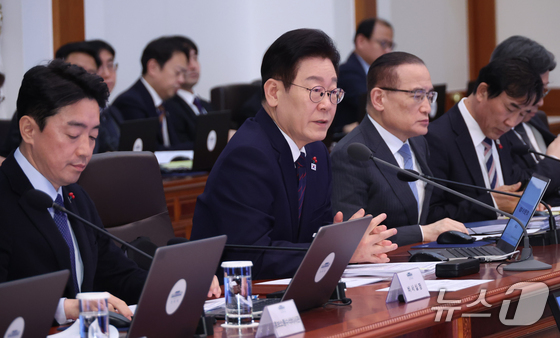
Caught off guard by the unexpected U.S. announcement, the Blue House and government officials quickly convened an emergency meeting to formulate a response.
President Trump took to his social media platform, Truth Social, stating that the South Korean National Assembly was failing to fulfill its obligations under the trade agreement. He added that he and South Korean President Lee Jae Myung had signed an excellent trade deal benefiting both nations on July 30, 2025, which he reaffirmed during his visit to Korea on October 29, 2025, questioning why the South Korean National Assembly had yet to approve the agreement.
Trump went on to say that because the National Assembly had failed to legislate what he described as a historic trade agreement, he would raise tariffs on automobiles, lumber, pharmaceuticals, and all other mutual tariffs from 15% to 25%.
Last October 29, the U.S. and South Korea finalized trade negotiations during a summit in Gyeongju. The U.S. agreed to reduce mutual tariffs and item tariffs, including those on automobiles, from 25% to 15%, in exchange for South Korea’s commitment of 350 billion USD in investment.
At that time, the U.S. planned to lower tariffs in tandem with the South Korean National Assembly’s proposal of special legislation to facilitate U.S. investment. The “Special Act for Strategic Investment Management between Korea and the U.S.,” a follow-up measure to the bilateral memorandum of understanding (MOU), was proposed on November 26 last year. The U.S. subsequently published the tariff reduction measures in the Federal Register on December 4.
The agreement did not specify a timeline for the special law’s passage in the National Assembly. Nevertheless, Trump’s sudden tariff hike is seen as a critique of delays in South Korea’s investment in the U.S. The special law is currently pending in the National Assembly’s Strategy and Finance Committee.
The South Korean government and ruling party have argued that immediate large-scale investment in the U.S. is challenging due to volatility in the foreign exchange market, driven by a rising dollar-won exchange rate. The agreement includes a provision capping South Korea’s annual U.S. investment at 20 billion USD, with the option to request adjustments in timing and amounts if foreign exchange market instability is a concern.
The Trump administration’s decision to reinstate tariffs has put both the government and the National Assembly under intense pressure. The timing of the announcement, coming shortly after Prime Minister Kim Min Seok’s U.S. visit, has officials scrambling to decipher the Trump administration’s intentions.
The Blue House said it was working to assess the situation, adding on Tuesday that it had not yet received any official notification or detailed explanation from the U.S. government. It noted that a response meeting with relevant ministries, to be chaired by Kim Yong-beom, was scheduled for that morning.
The government plans to urgently dispatch the Minister of Trade, Industry and Energy, Kim Jeong Kwan, who is currently in Canada, to the United States. Minister Kim is set to engage in discussions with U.S. Secretary of Commerce Howard Lutnick.
Meanwhile, the National Assembly’s Strategy and Finance Committee will meet with Deputy Prime Minister and Minister of Economy and Finance Koo Yun Cheol to discuss countermeasures against the U.S. tariff increase.
Jeong Tae Ho, the ruling party’s secretary of the Strategy and Finance Committee, said in a press release that the U.S.–Korea agreement pertained to the proposal of a bill, not its passage timeline. He added that five special laws had been proposed, but that December’s tax reviews and January’s personnel hearings had prevented individual bill reviews, noting that future discussions would proceed through normal legislative channels.