

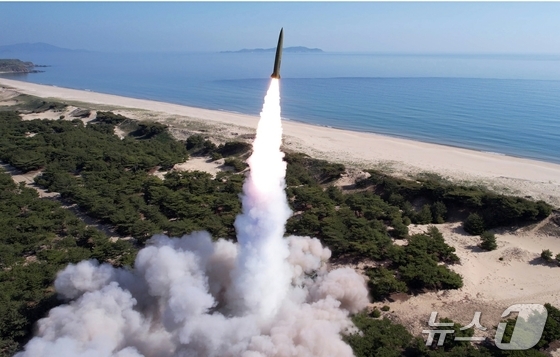
North Korea launched several short-range ballistic missiles (SRBMs) into the East Sea on Tuesday afternoon, coinciding with Under Secretary of Defense for Policy Elbridge Colby’s tour of Asia.
The Joint Chiefs of Staff reported that South Korean forces detected multiple short-range ballistic missiles fired from an area north of Pyongyang toward the East Sea at approximately 3:50 p.m. The missiles traveled about 350 kilometers (about 217 miles), with U.S. and South Korean officials currently conducting a detailed analysis of their specifications.
Military experts believe the missiles could be 600mm super-large multiple rocket launchers. With a maximum range of roughly 400 kilometers (about 249 miles), these weapons are likely designed to target key facilities in South Korea rather than the U.S. mainland.
This launch marks North Korea’s second provocative act of the year, coming 23 days after their January 4 missile test, which Pyongyang claimed was a hypersonic missile training exercise.
The timing of this SRBM launch, coinciding with Under Secretary Colby’s Asian tour to discuss the new U.S. National Defense Strategy (NDS), appears to be a deliberate show of force. Analysts suggest it’s aimed at challenging U.S. strategic planning in the region.
The new NDS outlines a shift in approach, with South Korea taking the lead in countering North Korean threats while the U.S. provides important but limited support. Pyongyang’s continued provocations may be intended to signal that this new strategy will be insufficient to counter their military capabilities.
Some experts also speculate that these actions could be aimed at bolstering internal unity ahead of the upcoming 9th Workers’ Party Congress next month.
The Joint Chiefs of Staff are closely monitoring the situation and sharing intelligence with U.S. and Japanese counterparts. U.S. Forces Korea quickly assessed that the launches do not pose an immediate threat to U.S. personnel, territory, or allies, reaffirming America’s commitment to defending its homeland and regional partners.
Japan’s Ministry of Defense reported that North Korea launched two probable ballistic missiles, both believed to have landed outside Japan’s Exclusive Economic Zone (EEZ).