

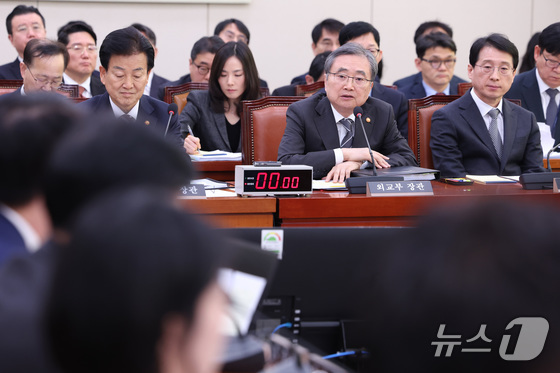
On Wednesday, during a session of the National Assembly’s Foreign Affairs and Unification Committee, lawmakers engaged in a heated debate over who was responsible for President Donald Trump’s sudden announcement of increased tariffs on South Korea.
The opposition criticized the government and ruling party for their complacency, insisting on the need for National Assembly approval. In contrast, the ruling party labeled this demand as an attempt to obstruct national governance.
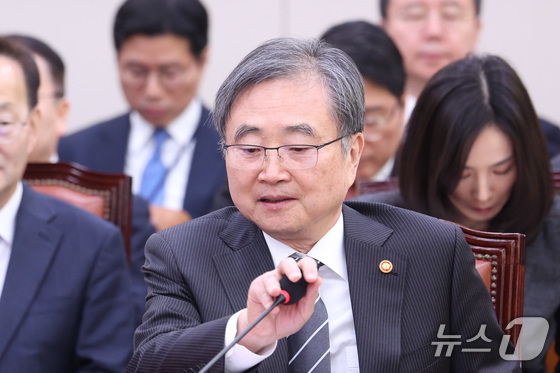
Song Eon Seok, the floor leader of the People Power Party and a member of the Foreign Affairs Committee, slammed Prime Minister Kim Min Seok at the committee meeting. He criticized the prime minister for boasting about promising faithful implementation of follow-up actions from tariff negotiations and establishing a hotline with Vice President JD Vance, only for President Trump to raise tariffs to 25% the very next day, asking how the government could explain that to the public.
Song continued that President Trump’s statement raised questions about why the Korean legislature did not approve the Special Law on U.S. Investment, and suggested it was essentially asking why there was no National Assembly approval, adding that if there was anything the public did not know, the government should obtain National Assembly consent.
Representative Kim Ki Hyun remarked that the prime minister spoke as if he had achieved something remarkable, presenting the hotline as the main outcome, but added that it offered no meaningful help in addressing the situation and did nothing to resolve the core issues.
Representative Kim Tae Ho added that the country was blindsided before the ink on the trade negotiation agreement had even dried, and questioned what the government had done to leave South Korea exposed to such a situation.
Representative Ahn Cheol Soo referenced Heinrich’s Law, which suggests that numerous warning signs often precede a major incident, and argued that the government should have recognized early red flags. He pointed out that President Yoon did not even receive a proper send-off after the usual Korea-U.S. talks.
Former diplomat Kim Geon stated that if the issue burdens citizens, it is only natural to seek the consent of the National Assembly and the public. He added that allowing the government to spend hundreds of trillions of won without oversight runs counter to the Constitution.
In contrast, the Democratic Party argued that the opposition was obstructing governance amid the Trump administration’s unilateral actions.
Representative Lee Jae Jung stated that no one could deny Trump’s unique approach and criticized the People Power Party for diminishing South Korea’s agility in diplomatic and economic matters.
He reiterated that a special law should be enacted rather than seeking National Assembly approval, arguing that no other country had undergone a ratification process for tariff negotiations.
Representative Kim Young Bae asserted that, from President Trump’s perspective, the issue was more about the swift implementation of the MOU’s contents than about South Korea breaking promises, and argued that it was against national interests for the opposition to demand approval now after having already agreed to the bill’s passage.
Representative Kim Sang Wook remarked that decision-making within the U.S. government seemed to occur department by department, with the vice president and the secretary of commerce operating separately, and added that, even with entrenched practices in South Korea’s government, improvements and reforms were needed to enable flexible collaboration in the national interest.
During the session, lawmakers also discussed incidents involving North Korean drones and the issue of contaminated water discharge from Fukushima.